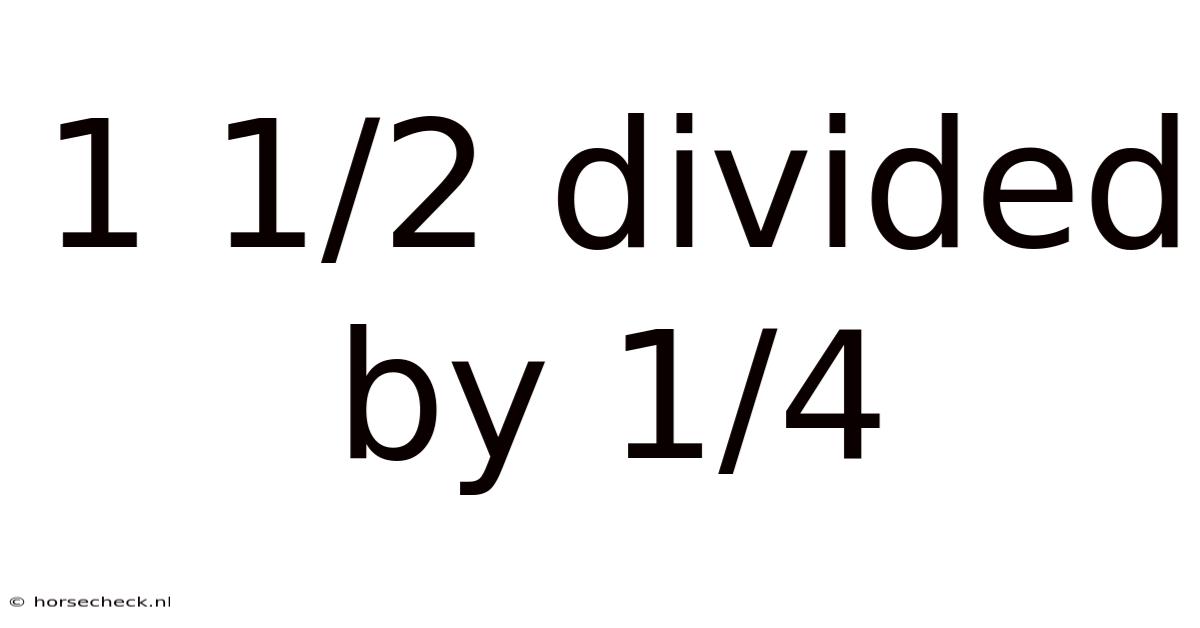
Unpacking 1 1/2 Divided by 1/4: A Deep Dive into Fraction Division
Dividing fractions can seem daunting, especially when mixed numbers are involved. This practical guide will break down the process of solving 1 1/2 divided by 1/4, explaining not only the steps but also the underlying mathematical principles. Consider this: we'll explore various methods, address common misconceptions, and break down the practical applications of this type of problem. By the end, you'll not only understand how to solve this specific problem but also confidently tackle any fraction division challenge And it works..
Understanding the Problem: 1 1/2 ÷ 1/4
Before diving into the solution, let's clarify the problem: 1 1/2 ÷ 1/4. This question asks: "How many times does 1/4 fit into 1 1/2?" This phrasing helps visualize the problem and makes the process more intuitive That's the part that actually makes a difference. Which is the point..
Method 1: Converting to Improper Fractions
It's a widely used and generally preferred method. It involves converting the mixed number (1 1/2) into an improper fraction before performing the division.
Step 1: Convert the Mixed Number to an Improper Fraction
A mixed number consists of a whole number and a fraction. To convert 1 1/2 to an improper fraction, we multiply the whole number (1) by the denominator (2), add the numerator (1), and keep the same denominator (2). This gives us:
1 1/2 = (1 * 2 + 1) / 2 = 3/2
Step 2: Invert the Second Fraction and Multiply
The key to dividing fractions is to invert (or reciprocate) the second fraction and then multiply. The reciprocal of 1/4 is 4/1 (or simply 4). So our problem becomes:
3/2 ÷ 1/4 = 3/2 * 4/1
Step 3: Multiply the Numerators and Denominators
Now, multiply the numerators together and the denominators together:
(3 * 4) / (2 * 1) = 12/2
Step 4: Simplify the Result
Finally, simplify the resulting fraction by dividing the numerator by the denominator:
12/2 = 6
Because of this, 1 1/2 divided by 1/4 equals 6.
Method 2: Visual Representation
A visual approach can make fraction division more intuitive, particularly for beginners. Imagine you have 1 1/2 pizzas, and each serving is 1/4 of a pizza.
Step 1: Visualizing 1 1/2
Draw a diagram representing 1 1/2 pizzas. You'll have one whole pizza and half a pizza Small thing, real impact..
Step 2: Visualizing 1/4 Servings
Now, divide each pizza into four equal quarters (1/4). You'll see that the whole pizza is divided into four quarters, and the half pizza is divided into two quarters Small thing, real impact..
Step 3: Counting the Servings
Count the total number of 1/4 servings. You'll have four quarters from the whole pizza and two quarters from the half pizza, making a total of six 1/4 servings.
This visual method confirms that 1 1/2 ÷ 1/4 = 6.
Method 3: Using Decimal Equivalents
While generally less preferred for maintaining accuracy, especially with complex fractions, using decimal equivalents can offer a quick estimate Small thing, real impact..
Step 1: Convert Fractions to Decimals
Convert both fractions to decimals:
1 1/2 = 1.5 1/4 = 0.25
Step 2: Perform Decimal Division
Divide the decimal equivalents:
1.5 ÷ 0.25 = 6
This method provides the same answer, 6, though it’s crucial to remember that rounding errors might occur with more complex fractions It's one of those things that adds up..
The Mathematical Rationale: Why Does Inverting and Multiplying Work?
The method of inverting the second fraction and multiplying is not arbitrary. Division is essentially the inverse operation of multiplication. It stems from the definition of division. When we divide a by b (a ÷ b), we're essentially asking, "What number multiplied by b equals a?
In the context of fractions, a ÷ b/c can be rewritten as a * c/b. And this is because to find the answer, we must determine a number multiplied by b/c that results in a. By switching to multiplication and inverting the divisor, we get the equation in a more solvable form.
Addressing Common Misconceptions
-
Incorrect Order of Operations: It's crucial to remember the order of operations (PEMDAS/BODMAS). In fraction division, you do not add or subtract before dividing; handle fraction conversion and division first before any other operations.
-
Confusing Reciprocals: Many students mistake the reciprocal. The reciprocal of a fraction is simply the fraction flipped (numerator and denominator swapped). The reciprocal of 1/4 is 4/1, not 4/4 or 1/4 Nothing fancy..
Practical Applications
Understanding fraction division is vital in various real-life situations:
-
Cooking: Dividing recipes to adjust portion sizes. If a recipe calls for 1 1/2 cups of flour and you want to make 1/4 of the recipe, you'll need to calculate 1 1/2 ÷ 4 Still holds up..
-
Sewing: Calculating fabric needed for smaller projects based on pattern requirements And that's really what it comes down to. Nothing fancy..
-
Construction: Dividing materials for building projects based on measurements.
-
Data Analysis: Proportionate analysis of data involving fractional parts.
Frequently Asked Questions (FAQ)
Q: Can I solve this problem using a calculator?
A: Yes, most calculators can handle fraction division. Enter the numbers correctly (often using a fraction button or parentheses to indicate the fraction) to obtain the answer.
Q: What if the fractions are more complex?
A: The same principles apply. Convert mixed numbers to improper fractions, invert the second fraction, multiply, and simplify.
Q: Is there only one correct way to solve this problem?
A: While the methods presented here are common and effective, there might be minor variations. That said, the fundamental steps of converting to improper fractions, inverting and multiplying remain crucial.
Q: What if I get a fraction as an answer?
A: If you have an improper fraction as your answer, convert it back to a mixed number to represent the result more clearly.
Q: Why is it important to simplify fractions?
A: Simplifying fractions gives the answer in its simplest form, making it easier to understand and use No workaround needed..
Conclusion
Dividing 1 1/2 by 1/4 yields the answer 6. This seemingly simple calculation reveals the fundamental concepts of fraction manipulation, emphasizing the importance of converting mixed numbers, inverting the divisor, and multiplying. In practice, mastering these steps provides a solid foundation for tackling more complex fraction division problems encountered in various academic and real-world applications. By understanding the mathematical logic and practicing with different examples, you can confidently deal with the world of fractions and develop a stronger mathematical intuition. Remember to visualize the problem, practice regularly, and embrace the power of understanding underlying mathematical concepts.
