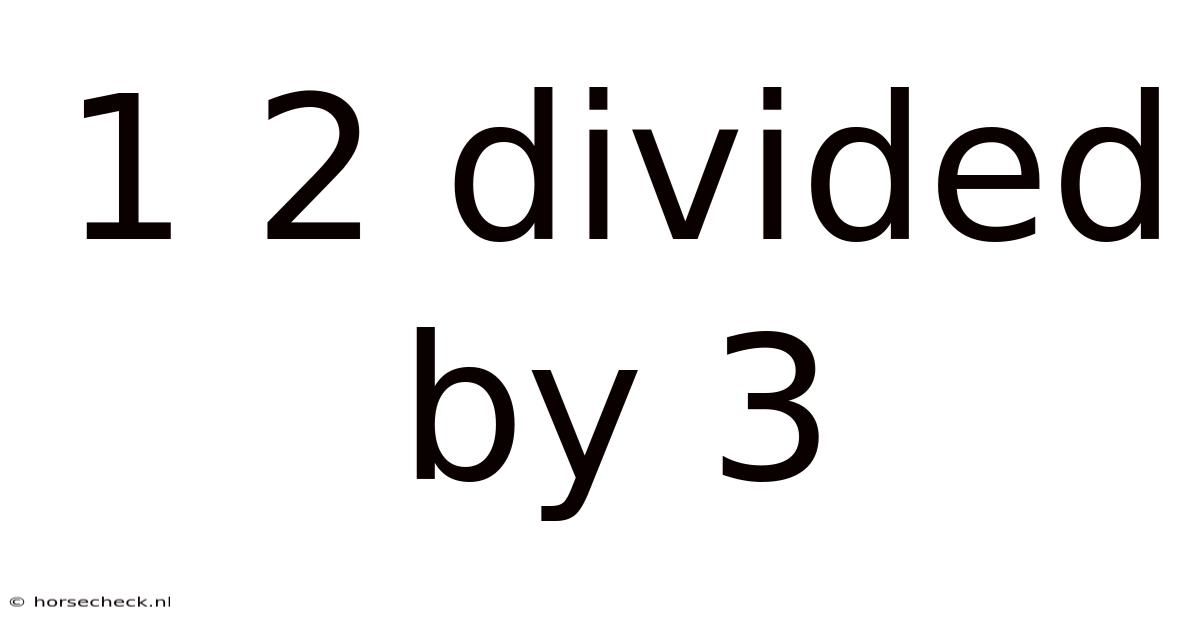
Decoding 1 2/3: A Deep Dive into Mixed Numbers and Division
Understanding fractions and mixed numbers is fundamental to mastering mathematics. This article looks at the seemingly simple calculation of "1 2/3 divided by 3," exploring not just the solution but the underlying principles and various methods to solve it. We'll cover the conversion of mixed numbers to improper fractions, the rules of fraction division, and practical applications, ensuring a comprehensive understanding for students and adults alike. This will equip you with the knowledge to tackle similar problems with confidence and clarity.
This is the bit that actually matters in practice.
Introduction: Understanding Mixed Numbers and Division
The expression "1 2/3 divided by 3" involves a mixed number (1 2/3) and a whole number (3). Practically speaking, a mixed number combines a whole number and a proper fraction (a fraction where the numerator is smaller than the denominator). Understanding how to handle these types of calculations is crucial for various mathematical applications, from simple everyday calculations to more complex problems in algebra and calculus. This article provides a step-by-step guide, explaining the rationale behind each step and offering alternative approaches.
Step-by-Step Calculation: Converting to Improper Fractions
The most efficient way to divide a mixed number by a whole number is to first convert the mixed number into an improper fraction. An improper fraction has a numerator larger than or equal to its denominator.
- Convert the Mixed Number to an Improper Fraction:
To convert 1 2/3 to an improper fraction, we follow these steps:
- Multiply the whole number by the denominator: 1 * 3 = 3
- Add the numerator: 3 + 2 = 5
- Keep the same denominator: The denominator remains 3.
Which means, 1 2/3 is equivalent to the improper fraction 5/3.
- Rewrite the Division Problem:
Our problem now becomes: 5/3 ÷ 3
- Dividing Fractions:
Dividing by a whole number is the same as multiplying by its reciprocal. The reciprocal of a number is simply 1 divided by that number. The reciprocal of 3 is 1/3.
So, our problem transforms into: 5/3 * 1/3
- Multiply the Numerators and Denominators:
To multiply fractions, we multiply the numerators together and the denominators together:
(5 * 1) / (3 * 3) = 5/9
Because of this, 1 2/3 divided by 3 equals 5/9.
Alternative Approach: Dividing Each Part Separately
While converting to an improper fraction is generally the most efficient method, we can also solve this problem by dividing each part of the mixed number separately. This approach, although more complex, can offer a deeper understanding of the underlying principles.
No fluff here — just what actually works.
- Divide the Whole Number:
Divide the whole number part of the mixed number (1) by 3: 1 ÷ 3 = 1/3
- Divide the Fractional Part:
Divide the fractional part (2/3) by 3: (2/3) ÷ 3 = 2/9
- Combine the Results:
Add the results from steps 1 and 2: 1/3 + 2/9
To add these fractions, we need a common denominator, which is 9:
(3/9) + (2/9) = 5/9
Again, we arrive at the answer: 5/9
Illustrative Examples: Real-World Applications
Understanding this type of calculation has practical applications in various scenarios. Consider these examples:
-
Recipe Scaling: If a recipe calls for 1 2/3 cups of flour and you want to make only one-third of the recipe, you would need to calculate (1 2/3) ÷ 3 = 5/9 cups of flour Took long enough..
-
Resource Allocation: If you have 1 2/3 meters of fabric and need to divide it equally among 3 people, each person receives 5/9 meters of fabric.
-
Data Analysis: In statistical calculations or data analysis involving proportions, you might encounter similar scenarios where dividing a mixed number is necessary Turns out it matters..
Explanation with Scientific Notation and Decimal Conversion
While the fraction 5/9 is the most accurate representation, we can also express the answer using decimal notation or scientific notation That's the part that actually makes a difference..
- Decimal Conversion:
To convert the fraction 5/9 to a decimal, we perform the division: 5 ÷ 9 ≈ 0.555... (a recurring decimal).
- Scientific Notation:
While less common for this specific value, we could express the decimal approximation in scientific notation: 5.56 x 10<sup>-1</sup> (rounded to two decimal places). On the flip side, the fractional form (5/9) is generally preferred for its accuracy.
Frequently Asked Questions (FAQ)
Q1: Why is converting to an improper fraction preferred?
Converting to an improper fraction simplifies the division process, making it a more streamlined and efficient method. It eliminates the need for separate division of the whole and fractional parts.
Q2: Can I use a calculator for this problem?
Yes, most calculators can handle fraction calculations. Even so, understanding the underlying principles is crucial for solving similar problems without a calculator and for building a strong mathematical foundation.
Q3: What if the divisor (the number we're dividing by) is a fraction itself?
If the divisor were also a fraction, we would still use the principle of multiplying by the reciprocal. Take this: (5/3) ÷ (2/3) would become (5/3) * (3/2) = 5/2 = 2 1/2.
Q4: Are there other ways to approach this problem?
Yes, there are alternative methods, such as using long division with decimals, but converting to an improper fraction is generally the most efficient and conceptually clear method.
Conclusion: Mastering Mixed Number Division
Understanding how to divide mixed numbers by whole numbers, as demonstrated with the example of 1 2/3 divided by 3, is a fundamental skill in mathematics. By mastering the conversion of mixed numbers to improper fractions and applying the rules of fraction division, you can confidently solve a wide range of problems involving fractions and mixed numbers. Day to day, remember, the key is to break down the problem into manageable steps, and the method of converting to an improper fraction simplifies the process significantly. This skill is not only useful for academic pursuits but also for everyday applications in various fields, making it a valuable addition to your mathematical toolkit.
