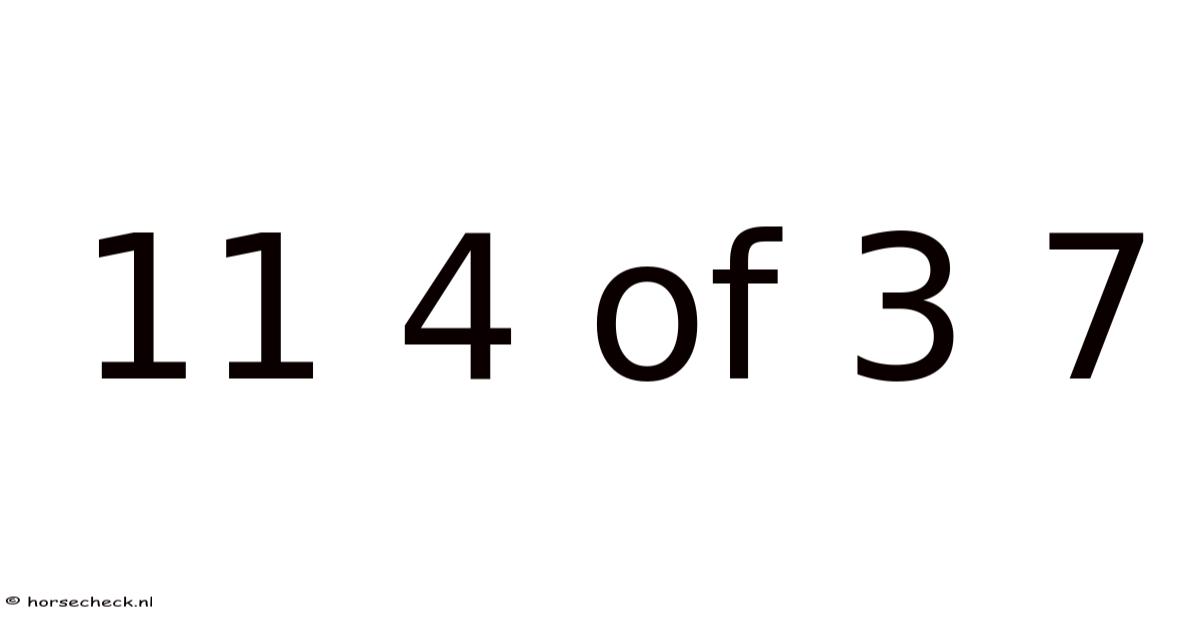
Decoding the Enigma: Unveiling the Secrets Behind "11 4 of 3 7"
This seemingly simple string of numbers, "11 4 of 3 7," presents a fascinating puzzle that looks at the realms of mathematics, logic, cryptography, and even a touch of lateral thinking. At first glance, it appears nonsensical, a random collection of digits. This article will explore various perspectives, examining the mathematical possibilities, logical deductions, and potential hidden codes within this intriguing sequence. On the flip side, a closer examination reveals a multitude of potential interpretations, each demanding a different approach to decipher its meaning. We will delve deep, revealing the underlying principles and demonstrating the multifaceted nature of problem-solving Small thing, real impact..
Introduction: The Allure of the Unknown
The allure of puzzles like "11 4 of 3 7" lies in their ambiguity. The lack of clear context invites speculation and the exploration of diverse problem-solving strategies. Now, it forces us to move beyond rote memorization and embrace critical thinking, pushing our cognitive boundaries to find a solution. The seemingly simple nature of the puzzle belies its potential complexity, making it an ideal subject for demonstrating different problem-solving approaches.
Mathematical Interpretations: Exploring Numerical Relationships
One approach is to examine the numbers purely from a mathematical perspective. We can explore various operations and relationships:
-
Addition and Subtraction: Simple addition (11 + 4 + 3 + 7 = 25) or subtraction combinations yield no immediately obvious pattern or meaningful result.
-
Multiplication and Division: Similarly, exploring multiplicative or divisive relationships between the numbers does not immediately reveal a clear solution. That said, we can explore factoring, prime numbers, and other number theory concepts. Are any of the numbers prime? Are there any common factors? Exploring these avenues might reveal subtle numerical relationships And it works..
-
Modular Arithmetic: This branch of mathematics deals with remainders after division. Analyzing the numbers modulo various bases (e.g., modulo 2, modulo 3, etc.) could potentially reveal hidden patterns or congruences. This requires a systematic approach, testing different moduli to identify any consistent relationships Easy to understand, harder to ignore..
-
Base Conversion: The numbers could be representations in different numerical bases (like binary, ternary, etc.). Converting each number to different bases and then comparing them might uncover a hidden pattern or connection. Take this case: converting 11 to binary gives 1011. Does this relate to the other numbers in a similar base?
-
Sequences and Series: The numbers might form part of a mathematical sequence or series. Examining their differences, ratios, or other patterns might reveal the underlying rule governing their arrangement. Are they Fibonacci-like? Are they part of an arithmetic or geometric progression? A thorough investigation of sequence properties is crucial here Small thing, real impact..
Logical and Cryptographic Approaches: Beyond Pure Mathematics
Moving beyond pure mathematics, we can explore logical and cryptographic approaches:
-
Pattern Recognition: A fundamental aspect of problem-solving involves identifying patterns. Are there any repeating elements, symmetrical arrangements, or other noticeable trends within the sequence? Careful observation is key to this method Practical, not theoretical..
-
Cipher Decryption: The string could represent a simple substitution cipher, where each number represents a letter of the alphabet. This requires assigning numerical values to letters and then attempting to decode the resulting message. Consider various substitution schemes (e.g., A=1, B=2, etc., or a more complex scheme).
-
Code Breaking: The sequence might be a fragment of a more complex code, requiring advanced cryptographic techniques to decipher. This would involve analyzing the frequency of the numbers, their distribution, and potential relationships with other known codes or ciphers Which is the point..
-
Lateral Thinking: Sometimes, the solution lies not in direct mathematical manipulation but in creative lateral thinking. Is there a hidden meaning or context to the numbers that isn’t immediately apparent? This approach encourages brainstorming and exploring unconventional interpretations Worth knowing..
A Step-by-Step Deciphering Process
Let's demonstrate a structured approach to deciphering "11 4 of 3 7," incorporating the methods discussed above:
-
Data Analysis: Begin by meticulously analyzing the individual numbers: 11, 4, 3, 7. Note their properties: 11 is prime; 4 is a perfect square; 3 is prime; 7 is prime. Are there any common factors or divisors?
-
Numerical Relationships: Explore the basic arithmetic operations (addition, subtraction, multiplication, division) and see if any obvious patterns emerge. Calculate the sum, differences, products, and quotients of various combinations of the numbers.
-
Pattern Search: Look for any recurring patterns or sequences. Are the numbers ascending, descending, or exhibiting any other noticeable trends?
-
Modular Arithmetic: Investigate the numbers modulo various bases. Take this: consider the remainders when the numbers are divided by 2, 3, 4, 5, and so on. Look for consistent remainders or patterns.
-
Base Conversion: Convert each number to different numerical bases (binary, ternary, hexadecimal, etc.). Analyze the converted numbers for patterns or relationships No workaround needed..
-
Substitution Ciphers: Explore simple substitution ciphers. Try assigning numerical values to letters of the alphabet (A=1, B=2, etc.) and see if any meaningful word or phrase emerges from the sequence. Experiment with different substitution schemes No workaround needed..
-
Lateral Thinking: Step back and consider the context. Is there any additional information or background that could illuminate the meaning of the sequence? Consider the possibility of hidden clues or metaphorical interpretations Easy to understand, harder to ignore..
Further Exploration and Potential Extensions
The exploration of "11 4 of 3 7" can extend far beyond the basic approaches described above. Here are some avenues for further investigation:
-
Advanced Cryptography: For those with expertise in cryptography, more complex ciphers could be investigated. The sequence might be part of a polyalphabetic substitution cipher, a transposition cipher, or a more elaborate code Worth keeping that in mind. Took long enough..
-
Mathematical Modeling: The numbers might represent parameters in a mathematical model, requiring advanced mathematical tools and techniques to decipher their meaning.
-
Computer-Aided Analysis: Computer programs can be used to automate the search for patterns, test different cryptographic approaches, and perform complex mathematical calculations Simple, but easy to overlook..
-
Collaboration and Brainstorming: Engaging in collaborative problem-solving can often lead to breakthroughs. Discussing the puzzle with others can spark new ideas and perspectives Not complicated — just consistent..
Frequently Asked Questions (FAQ)
-
Q: Is there a single, definitive answer to this puzzle?
- A: No, the ambiguity of "11 4 of 3 7" allows for multiple potential interpretations. The "correct" answer depends on the approach taken and the assumptions made.
-
Q: Are there any hints or clues to help solve this?
- A: The only hint is the sequence itself. The challenge is to explore various methods and apply creativity to decipher its meaning.
-
Q: What if I can't find a solution?
- A: Don't be discouraged! The beauty of this type of puzzle is that the process of exploration and problem-solving is just as valuable as finding a final solution. It’s an exercise in critical thinking and ingenuity.
Conclusion: Embracing the Journey of Discovery
"11 4 of 3 7" serves as a compelling example of how a seemingly simple puzzle can offer a rich tapestry of possibilities. Its solution isn’t necessarily a single definitive answer but a journey of exploration, encompassing mathematical manipulation, logical reasoning, cryptographic techniques, and even lateral thinking. The true value lies not just in finding a solution, but in the process of applying different problem-solving strategies and appreciating the multifaceted nature of the challenge. This puzzle highlights the importance of critical thinking, perseverance, and the rewarding experience of unlocking the secrets hidden within seemingly random data. The journey of deciphering this enigma is as valuable, if not more so, than arriving at any particular conclusion. It encourages us to embrace the process of discovery and the joy of intellectual exploration.
