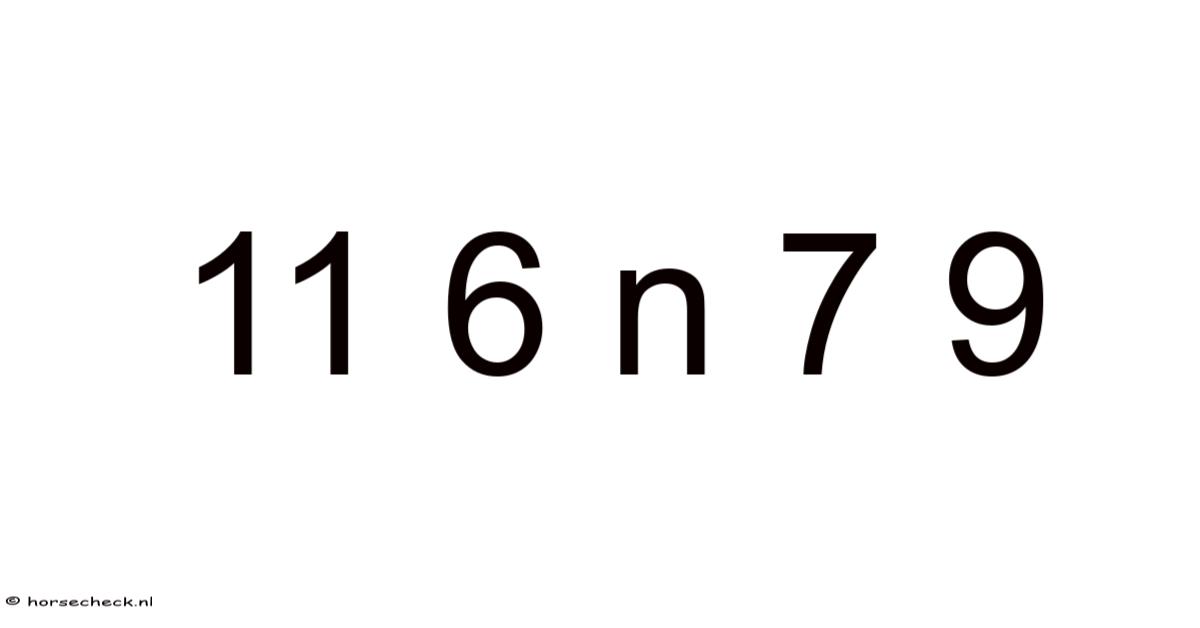
Decoding the Sequence: Unveiling the Patterns and Possibilities of 11 6 n 7 9
This article walks through the intriguing numerical sequence "11 6 n 7 9," exploring various mathematical and logical approaches to determine the unknown value 'n' and understand the underlying pattern. On the flip side, we will investigate potential relationships between the numbers, consider different mathematical operations, and ultimately aim to deduce a plausible solution and explore broader implications of pattern recognition. This seemingly simple sequence presents a fascinating challenge that touches upon fundamental concepts in mathematics and problem-solving The details matter here..
Understanding the Problem: Defining the Scope
The core challenge lies in identifying a consistent mathematical or logical relationship between the known numbers (11, 6, 7, 9) that allows us to predict the missing value 'n'. Also, the absence of explicit context requires us to explore multiple possibilities, ranging from simple arithmetic operations to more complex mathematical patterns or even hidden code-like sequences. Our analysis will focus on systematically exploring these possibilities to arrive at a solution that is both logical and mathematically sound.
Exploring Potential Mathematical Relationships
Let's start by investigating straightforward arithmetic relationships. We can examine differences, sums, products, and quotients between consecutive numbers:
-
Differences: The differences between consecutive known numbers are not immediately consistent: 11 - 6 = 5, 7 - 6 = 1, 9 - 7 = 2. This suggests a more complex relationship than simple subtraction Practical, not theoretical..
-
Sums: Adding consecutive numbers also doesn't reveal an obvious pattern: 11 + 6 = 17, 6 + 7 = 13, 7 + 9 = 16 Not complicated — just consistent..
-
Products: Multiplying consecutive numbers yields similarly inconsistent results: 11 x 6 = 66, 6 x 7 = 42, 7 x 9 = 63 Most people skip this — try not to. Practical, not theoretical..
-
Quotients: Dividing consecutive numbers doesn't lead to a clear pattern either The details matter here..
Given the inconsistency of these basic arithmetic operations, we need to explore more sophisticated methods.
Advanced Mathematical Approaches: Pattern Recognition and Series
Since simple arithmetic operations fail to reveal a consistent pattern, we can consider more advanced techniques:
-
Fibonacci-like Sequences: The Fibonacci sequence involves adding the two preceding numbers to obtain the next. While this sequence doesn't directly fit, variations or modifications might apply. Analyzing the differences between consecutive numbers and their potential relationships could hint at a modified Fibonacci or similar recursive sequence.
-
Polynomial Relationships: It's possible that the numbers in the sequence follow a polynomial relationship, meaning that they could be generated by a polynomial equation. To investigate this, we can attempt to fit a polynomial curve to the known data points. That said, with only four data points (excluding 'n'), determining a unique polynomial is challenging and might yield several potential solutions.
-
Modular Arithmetic: Modular arithmetic involves remainders after division. We could explore whether the sequence exhibits patterns when considering remainders after division by a particular number. This approach might reveal hidden cyclic patterns or relationships Small thing, real impact. But it adds up..
-
Geometric Series: A geometric series is where each term is obtained by multiplying the previous term by a constant. The given sequence does not immediately appear to be geometric, but modifications or partial geometric progressions could exist.
The exploration of these advanced mathematical methods often requires advanced statistical techniques or computational tools. Given the limited number of data points, the results from these analyses might offer several plausible solutions, and further information would be needed to determine the most accurate solution.
Exploring Logical and Contextual Possibilities
Beyond pure mathematics, let's consider other potential interpretations:
-
Coded Sequences: The sequence could represent a coded message where each number corresponds to a letter or symbol. Without additional context or a code key, however, deciphering such a code would be speculative.
-
Hidden Patterns in Subsets: Perhaps specific combinations or subsets of numbers within the sequence reveal patterns. Analyzing the numbers in pairs or triplets could lead to hidden relationships. As an example, comparing the sums or differences of pairs might reveal a consistent pattern not apparent when examining the sequence linearly.
-
External Factors: If the sequence originates from a specific context (e.g., a real-world phenomenon, a game, or a puzzle), understanding that context is vital. The sequence's meaning could be contingent on information not provided within the sequence itself Still holds up..
The Importance of Additional Information
The ambiguity in determining 'n' underscores the critical need for additional context. If the sequence is part of a larger set, or if further numbers are provided, this would greatly aid in identifying the underlying pattern. The problem highlights the limitations of solving pattern recognition challenges with limited data.
Conclusion: Multiple Paths, One Solution?
The sequence "11 6 n 7 9" presents a compelling puzzle with multiple potential solutions, depending on the assumed underlying pattern. Practically speaking, simple arithmetic operations failed to reveal a clear solution, prompting the exploration of more sophisticated mathematical approaches and logical interpretations. The absence of explicit context adds complexity.
The exploration of this sequence showcases the importance of considering diverse mathematical tools and the role of context in solving problems. The ambiguity emphasizes the value of having sufficient data for accurate analysis and the limitations of drawing definitive conclusions from limited information. But to confidently determine 'n', additional data or context related to the sequence's origin is crucial. Without further information, several plausible solutions remain possible. The exercise, however, serves as a valuable exploration of mathematical reasoning, problem-solving strategies, and the importance of context in pattern recognition That's the part that actually makes a difference. That alone is useful..
