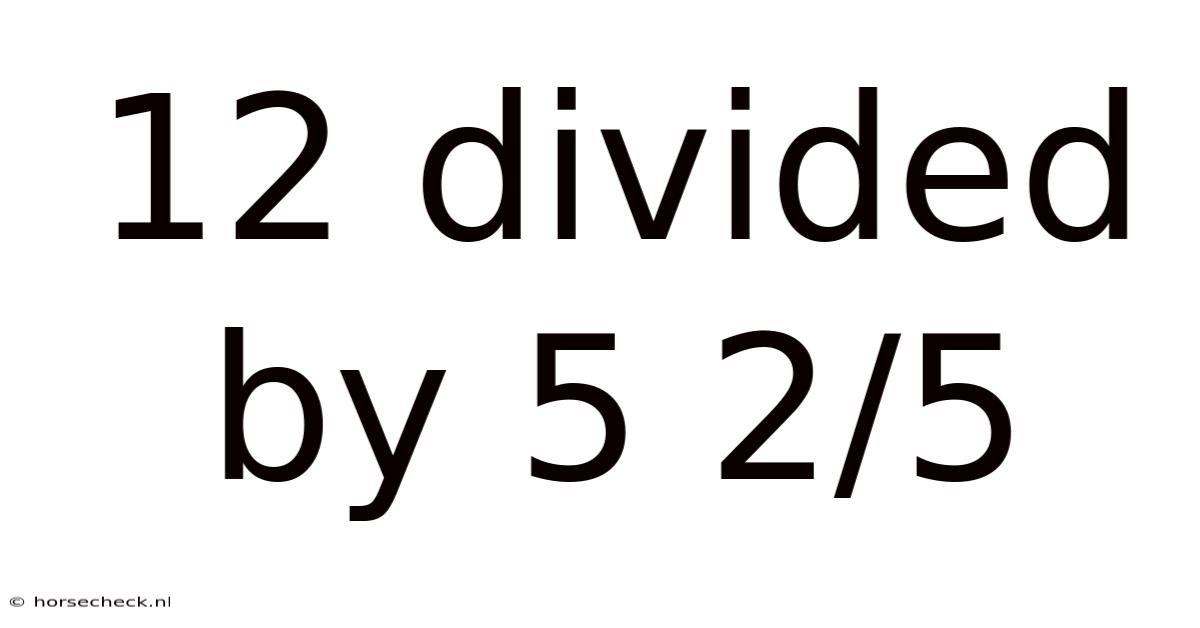
Decoding 12 Divided by 5 2/5: A practical guide to Fraction Division
Dividing fractions can seem daunting, but with a clear understanding of the process, it becomes manageable and even enjoyable. This article will walk you through solving the problem "12 divided by 5 2/5" step-by-step, explaining the underlying principles and offering helpful tips for tackling similar problems. We'll break down the theory behind fraction division, explore different methods, and address common misconceptions. By the end, you'll not only know the answer but also possess the confidence to tackle any fraction division problem Worth knowing..
Understanding the Problem: 12 ÷ 5 2/5
Before jumping into the solution, let's break down the problem. Here's the thing — we are asked to divide the whole number 12 by the mixed number 5 2/5. Remember, a mixed number is a combination of a whole number and a fraction (e.g.Worth adding: , 5 2/5). The key to solving this lies in converting the mixed number into an improper fraction and then applying the rules of fraction division.
Step 1: Converting Mixed Numbers to Improper Fractions
The first step is to transform the mixed number 5 2/5 into an improper fraction. An improper fraction has a numerator (top number) larger than or equal to its denominator (bottom number). To convert, follow these steps:
- Multiply the whole number by the denominator: 5 x 5 = 25
- Add the numerator to the result: 25 + 2 = 27
- Keep the same denominator: The denominator remains 5.
Which means, 5 2/5 becomes 27/5. Our problem now looks like this: 12 ÷ 27/5
Step 2: Reciprocating the Divisor
The next crucial step in dividing fractions involves reciprocating the second fraction (the divisor). That said, reciprocating a fraction means switching its numerator and denominator. The reciprocal of 27/5 is 5/27. Dividing by a fraction is the same as multiplying by its reciprocal Less friction, more output..
So, our equation now transforms into: 12 x 5/27
Step 3: Converting Whole Numbers to Fractions
To simplify the multiplication, let's convert the whole number 12 into a fraction. Any whole number can be expressed as a fraction with a denominator of 1. That's why, 12 becomes 12/1.
Our equation is now: 12/1 x 5/27
Step 4: Multiplying Fractions
Multiplying fractions is straightforward: multiply the numerators together and the denominators together And it works..
- Numerators: 12 x 5 = 60
- Denominators: 1 x 27 = 27
This gives us the improper fraction 60/27.
Step 5: Simplifying the Improper Fraction
The improper fraction 60/27 can be simplified. To simplify, we find the greatest common divisor (GCD) of the numerator and denominator. The GCD of 60 and 27 is 3.
- 60 ÷ 3 = 20
- 27 ÷ 3 = 9
This simplifies our answer to 20/9.
Step 6: Converting the Improper Fraction to a Mixed Number (Optional)
While 20/9 is a perfectly valid answer, it's often more practical to express the answer as a mixed number. To do this:
- Divide the numerator by the denominator: 20 ÷ 9 = 2 with a remainder of 2.
- The quotient becomes the whole number: 2
- The remainder becomes the numerator of the fraction: 2
- The denominator remains the same: 9
Because of this, the mixed number equivalent of 20/9 is 2 2/9 It's one of those things that adds up..
So, 12 divided by 5 2/5 is equal to 20/9, or 2 2/9.
Alternative Method: Decimal Conversion
Another way to solve this problem is by converting all numbers into decimals before performing the division.
- Convert 5 2/5 to a decimal: 5 2/5 = 5 + (2/5) = 5 + 0.4 = 5.4
- Divide 12 by 5.4: 12 ÷ 5.4 ≈ 2.222...
This decimal approximation (2.) is close to our fraction answer of 2 2/9. Plus, the slight discrepancy arises from rounding during the decimal conversion. Here's the thing — 222... The fraction answer (20/9 or 2 2/9) is generally preferred for accuracy And that's really what it comes down to. Turns out it matters..
The Science Behind Fraction Division
The process of dividing by a fraction hinges on the concept of reciprocals and the principle of maintaining the equivalence of the equation. When we divide by a fraction, we are essentially asking, "How many times does this fraction fit into the whole number (or another fraction)?Think about it: " Multiplying by the reciprocal effectively answers this question. This is a fundamental concept in algebra and is used extensively in various mathematical fields Which is the point..
Frequently Asked Questions (FAQs)
-
Why do we reciprocate the second fraction? Reciprocating the divisor and multiplying is equivalent to dividing by the original fraction. This method simplifies the calculation and avoids complex long division with fractions.
-
Can I convert to decimals every time? While you can use decimal conversions, it's not always the most accurate method, especially when dealing with repeating decimals. Working with fractions ensures precision.
-
What if I get a very large improper fraction? Always simplify your answer by finding the greatest common divisor (GCD) of the numerator and denominator. This makes the result easier to understand and work with It's one of those things that adds up. Turns out it matters..
-
Is there a different way to solve this problem? Yes, you could use long division with fractions, but it's more complex than the reciprocal method. The reciprocal method is generally preferred for its efficiency.
Conclusion:
Solving "12 divided by 5 2/5" requires a systematic approach involving converting mixed numbers to improper fractions, reciprocating the divisor, multiplying the fractions, and simplifying the result. Plus, don't be afraid to break down complex problems into smaller, manageable steps. Mastering fraction division is a crucial skill in mathematics, paving the way for more advanced concepts in algebra and beyond. Whether you express the final answer as an improper fraction (20/9) or a mixed number (2 2/9), the core mathematical principles remain consistent. Because of that, remember the steps, practice regularly, and you'll soon become proficient in tackling these types of problems with confidence. The key is to understand the why behind each step, not just the how Easy to understand, harder to ignore. And it works..
Some disagree here. Fair enough.
