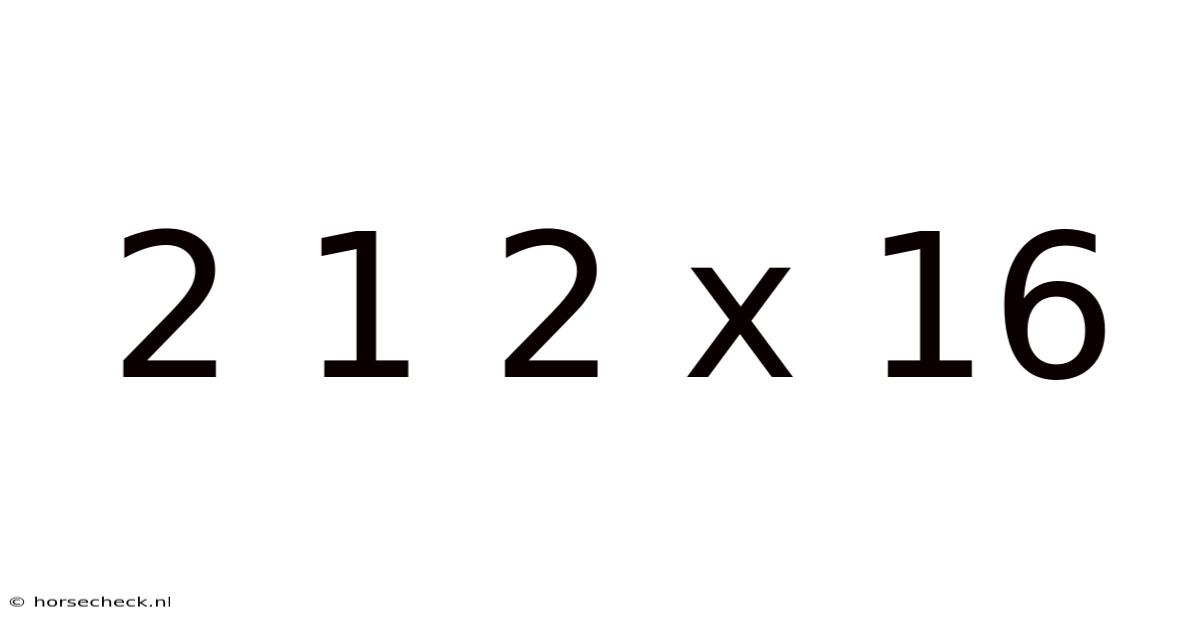
Decoding 2 1 2 x 16: A Deep Dive into Binary, Octal, and Hexadecimal Systems
Understanding different number systems is fundamental to computer science and digital electronics. While we're comfortable with the decimal system (base-10), computers operate using binary (base-2). This article will thoroughly explore the expression "2 1 2 x 16," deciphering its meaning and revealing the interconnectedness of binary, octal (base-8), and hexadecimal (base-16) number systems. We'll walk through the conversion processes, practical applications, and the significance of this specific representation in digital contexts.
Introduction: The Foundation of Number Systems
Before diving into the specifics of "2 1 2 x 16," let's establish a firm understanding of different number systems. Each system is defined by its base, which represents the number of unique digits used.
-
Decimal (Base-10): This is the system we use daily. It employs the digits 0-9. Each position represents a power of 10 (10<sup>0</sup>, 10<sup>1</sup>, 10<sup>2</sup>, etc.). To give you an idea, the number 123 is (1 x 10<sup>2</sup>) + (2 x 10<sup>1</sup>) + (3 x 10<sup>0</sup>).
-
Binary (Base-2): The foundation of digital electronics, binary uses only two digits: 0 and 1. Each position represents a power of 2 (2<sup>0</sup>, 2<sup>1</sup>, 2<sup>2</sup>, etc.). This simplicity makes it ideal for representing electrical signals (on/off, high/low voltage).
-
Octal (Base-8): Octal uses the digits 0-7. Each position represents a power of 8 (8<sup>0</sup>, 8<sup>1</sup>, 8<sup>2</sup>, etc.). Historically, octal was used as a shorthand for binary, as three binary digits can be represented by one octal digit That alone is useful..
-
Hexadecimal (Base-16): Hexadecimal uses the digits 0-9 and the letters A-F (A=10, B=11, C=12, D=13, E=14, F=15). Each position represents a power of 16 (16<sup>0</sup>, 16<sup>1</sup>, 16<sup>2</sup>, etc.). It’s a more compact representation of binary data than octal, as four binary digits can be represented by one hexadecimal digit.
Deciphering "2 1 2 x 16": A Multi-System Interpretation
The expression "2 1 2 x 16" likely represents a number expressed in multiple bases. The "2 1 2" part could represent a number in either octal or binary, while "x 16" indicates a multiplication by 16, suggesting a connection to the hexadecimal system. Let’s explore both possibilities:
This is where a lot of people lose the thread Most people skip this — try not to..
Possibility 1: Octal Interpretation
If "2 1 2" is an octal number, its decimal equivalent is calculated as:
(2 x 8<sup>2</sup>) + (1 x 8<sup>1</sup>) + (2 x 8<sup>0</sup>) = (2 x 64) + (1 x 8) + (2 x 1) = 128 + 8 + 2 = 138
Because of this, "2 1 2 x 16" in this interpretation would be 138 x 16 = 2208 Simple, but easy to overlook..
Possibility 2: Binary Interpretation with Octal Shorthand
The "2 1 2" could also be a shorthand representation of a binary number using octal groupings. Let's break down "2 1 2" into its individual octal digits and then convert each to its binary equivalent (three bits per octal digit):
People argue about this. Here's where I land on it.
- 2 (octal) = 010 (binary)
- 1 (octal) = 001 (binary)
- 2 (octal) = 010 (binary)
Combining these binary equivalents, we get: 010001010 (binary).
Converting this binary number to decimal:
(0 x 2<sup>8</sup>) + (1 x 2<sup>7</sup>) + (0 x 2<sup>6</sup>) + (0 x 2<sup>5</sup>) + (0 x 2<sup>4</sup>) + (1 x 2<sup>3</sup>) + (0 x 2<sup>2</sup>) + (1 x 2<sup>1</sup>) + (0 x 2<sup>0</sup>) = 128 + 8 + 2 = 138
This yields the same decimal result as the pure octal interpretation: 138. Which means, "2 1 2 x 16" would again be 138 x 16 = 2208 Simple, but easy to overlook..
Conversion Processes: A Detailed Walkthrough
Let's illustrate the conversion processes between these number systems with specific examples.
Decimal to Binary:
To convert a decimal number to binary, repeatedly divide by 2 and record the remainders. The remainders, read in reverse order, form the binary representation.
Example: Convert 2208 to binary:
| Division | Quotient | Remainder |
|---|---|---|
| 2208 / 2 | 1104 | 0 |
| 1104 / 2 | 552 | 0 |
| 552 / 2 | 276 | 0 |
| 276 / 2 | 138 | 0 |
| 138 / 2 | 69 | 0 |
| 69 / 2 | 34 | 1 |
| 34 / 2 | 17 | 0 |
| 17 / 2 | 8 | 1 |
| 8 / 2 | 4 | 0 |
| 4 / 2 | 2 | 0 |
| 2 / 2 | 1 | 0 |
| 1 / 2 | 0 | 1 |
Reading the remainders from bottom to top: 100010001100 (binary)
Decimal to Octal:
Similarly, for conversion to octal, repeatedly divide by 8 and record the remainders That alone is useful..
Example: Convert 138 to octal:
| Division | Quotient | Remainder |
|---|---|---|
| 138 / 8 | 17 | 2 |
| 17 / 8 | 2 | 1 |
| 2 / 8 | 0 | 2 |
Reading the remainders from bottom to top: 212 (octal)
Decimal to Hexadecimal:
For hexadecimal, repeatedly divide by 16. Remainders 10-15 are represented by A-F.
Example: Convert 2208 to hexadecimal:
| Division | Quotient | Remainder | Hexadecimal Equivalent |
|---|---|---|---|
| 2208 / 16 | 138 | 0 | 0 |
| 138 / 16 | 8 | 10 | A |
| 8 / 16 | 0 | 8 | 8 |
Reading the remainders from bottom to top: 8A0 (hexadecimal)
Binary to Octal/Hexadecimal:
Grouping binary digits (3 for octal, 4 for hexadecimal) simplifies conversion.
Example: Convert 100010001100 (binary) to octal:
Group into threes from right to left: 1 000 100 011 00. Convert each group to its octal equivalent: 1 0 4 3 0 (octal) = 10430 (octal). Note that leading zeros are significant here in determining octal values But it adds up..
Convert 100010001100 (binary) to hexadecimal:
Group into fours: 1000 1000 1100. Convert each group: 8 8 C (hexadecimal) = 88C (hexadecimal).
Practical Applications: Where These Systems Matter
The significance of binary, octal, and hexadecimal systems extends beyond theoretical exercises. They are crucial in various fields:
-
Computer Architecture: Computers fundamentally operate using binary, representing data and instructions as sequences of 0s and 1s Nothing fancy..
-
Programming: While programmers rarely write directly in binary, understanding its relationship to higher-level representations (octal, hexadecimal) is essential for debugging, memory management, and low-level programming Easy to understand, harder to ignore..
-
Digital Signal Processing: These systems are integral to processing and representing digital signals in fields like telecommunications and audio engineering That's the part that actually makes a difference. Worth knowing..
-
Data Representation: Hexadecimal is often used to represent memory addresses, color codes (e.g., in web design – #RRGGBB), and other data concisely.
Frequently Asked Questions (FAQ)
Q: Why are octal and hexadecimal used if binary is the fundamental system?
A: Binary representations can become very long and difficult to read. Octal and hexadecimal provide more compact and human-readable ways to represent binary data That's the part that actually makes a difference..
Q: What are the limitations of these number systems?
A: The limitations are primarily related to their base. Binary requires many digits to represent large numbers. Octal and hexadecimal are more efficient but still less intuitive than the familiar decimal system for many users.
Q: Can any number be represented in any of these bases?
A: Yes, any number that can be represented in one base can be represented in any other base. The only difference is the number of digits required.
Conclusion: Mastering the Art of Numerical Representation
Understanding the interplay between binary, octal, hexadecimal, and the decimal system is vital for anyone working with computers or digital technology. Practically speaking, by mastering these concepts, you gain a deeper understanding of the underlying principles that power the digital world. Continue to explore these concepts and enhance your understanding of how computers process and store information. So the seemingly simple expression "2 1 2 x 16" opens a window into a rich and complex world of numerical representation, essential for navigating the digital age. This article has provided a detailed exploration of the "2 1 2 x 16" expression, illustrating different interpretations and highlighting the crucial conversion processes between these number systems. The journey of learning is ongoing, and each step forward builds a stronger foundation for future discoveries Which is the point..
