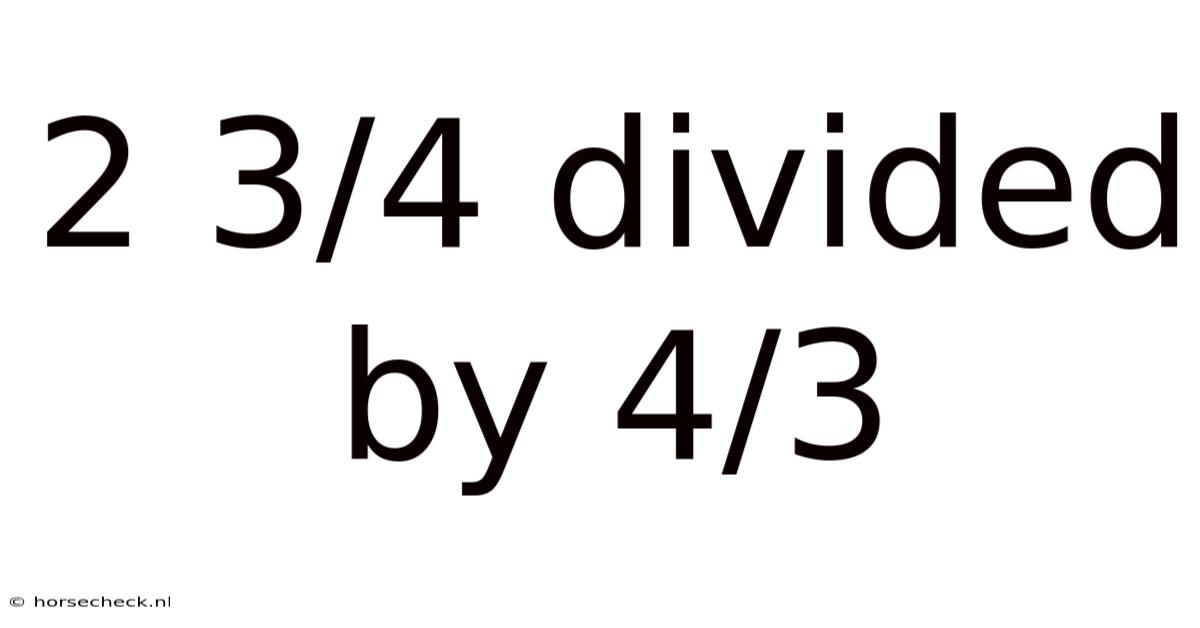
Diving Deep into 2 3/4 Divided by 4/3: A complete walkthrough
Dividing fractions and mixed numbers can seem daunting, but with a systematic approach, it becomes a straightforward process. We'll cover various methods, address common misconceptions, and even walk through the real-world applications of such calculations. This article will thoroughly explore the division of 2 3/4 by 4/3, breaking down each step, providing explanations, and offering insights into the underlying mathematical principles. By the end, you'll not only understand how to solve this specific problem but also gain the confidence to tackle similar fraction division problems independently Easy to understand, harder to ignore. Practical, not theoretical..
You'll probably want to bookmark this section.
Understanding the Problem: 2 3/4 ÷ 4/3
Before jumping into the solution, let's clarify what the problem entails: 2 3/4 ÷ 4/3 means "how many times does 4/3 go into 2 3/4?" This phrasing helps visualize the division process. We are essentially trying to determine how many groups of 4/3 we can create from a total of 2 3/4 Simple as that..
Method 1: Converting to Improper Fractions
The most common and generally recommended approach is to convert both the mixed number and the proper fraction into improper fractions. This simplifies the division process significantly And that's really what it comes down to. Nothing fancy..
Step 1: Convert 2 3/4 to an improper fraction.
To do this, we multiply the whole number (2) by the denominator (4), add the numerator (3), and keep the same denominator (4). This gives us:
(2 * 4) + 3 = 11
Because of this, 2 3/4 becomes 11/4.
Step 2: Rewrite the problem with improper fractions.
Our problem now looks like this: 11/4 ÷ 4/3
Step 3: Invert the second fraction and multiply.
This is the crucial step in dividing fractions. Instead of dividing by 4/3, we multiply by its reciprocal, which is 3/4. The reciprocal of a fraction is simply obtained by swapping the numerator and the denominator.
11/4 * 3/4
Step 4: Multiply the numerators and the denominators.
Multiply the numerators together (11 * 3 = 33) and the denominators together (4 * 4 = 16). This gives us:
33/16
Step 5: Simplify (if possible).
In this case, 33/16 is an improper fraction. We can convert it back to a mixed number by dividing the numerator (33) by the denominator (16) Turns out it matters..
33 ÷ 16 = 2 with a remainder of 1
Because of this, 33/16 is equivalent to 2 1/16 Turns out it matters..
Method 2: Using Decimal Equivalents
Alternatively, we can solve the problem by converting both the mixed number and the fraction into their decimal equivalents. This approach can be quicker for those comfortable with decimal calculations.
Step 1: Convert 2 3/4 to a decimal.
2 3/4 can be rewritten as 2 + 3/4. Since 3/4 = 0.Even so, 75, 2 3/4 equals 2. 75.
Step 2: Convert 4/3 to a decimal.
4/3 = 1.3333... (This is a repeating decimal). So for practical purposes, we can round it to a sufficient number of decimal places, say 1. 33 Easy to understand, harder to ignore..
Step 3: Perform the decimal division.
Now we have 2.Practically speaking, 75 ÷ 1. 33.
2.75 ÷ 1.33 ≈ 2.0676...
Step 4: Round the decimal (if needed).
Depending on the desired level of precision, we can round the result. Day to day, for instance, rounding to two decimal places gives us 2. 07.
Note: This method introduces a slight inaccuracy due to the rounding of the decimal equivalents. The improper fraction method is more precise.
Understanding the Underlying Principles
The reason we invert and multiply when dividing fractions stems from the definition of division. Dividing by a fraction is the same as multiplying by its reciprocal. Consider the example a ÷ (b/c). To solve this, we multiply 'a' by the reciprocal of (b/c), which is (c/b). Now, this gives us (a * c) / b. This principle works because dividing by a fraction is equivalent to finding out how many times that fraction fits into the dividend Simple, but easy to overlook. Less friction, more output..
Real-World Applications
Fraction division is used extensively in various real-world scenarios:
- Cooking and Baking: Adjusting recipes to serve more or fewer people often involves dividing or multiplying fractional amounts of ingredients.
- Construction and Engineering: Calculating the amount of materials needed for a project often requires precise fraction calculations.
- Sewing and Tailoring: Cutting fabric accurately involves precise measurements and fractional calculations.
- Finance and Budgeting: Dividing expenses across different categories or allocating funds based on proportions frequently uses fractions.
Frequently Asked Questions (FAQ)
Q1: Can I use a calculator to solve this problem?
A1: Yes, you can use a calculator, but it's crucial to understand the underlying mathematical concepts. A calculator will provide the answer, but it won't teach you how to solve similar problems manually.
Q2: Is there only one correct method to solve this problem?
A2: While the improper fraction method is generally preferred for its accuracy, using decimal equivalents is a viable alternative, particularly when dealing with simple fractions or when an approximate answer is sufficient.
Q3: Why is it important to convert mixed numbers to improper fractions before dividing?
A3: Converting to improper fractions simplifies the calculation process. It allows for a consistent and straightforward application of the "invert and multiply" rule, avoiding potential errors associated with handling whole numbers and fractions simultaneously Most people skip this — try not to..
Q4: What if the resulting fraction is not easily simplified?
A4: If the resulting fraction cannot be simplified easily, you can leave it as an improper fraction or convert it to a decimal approximation, depending on the context and required precision Worth keeping that in mind..
Conclusion
Dividing fractions, even mixed numbers like 2 3/4 divided by 4/3, is a manageable task when approached systematically. Here's the thing — understanding the underlying principles and practicing various methods will enhance your ability to confidently solve similar problems in various real-world situations. Remember to always check your answer and consider the level of precision required based on the context of the problem. Now, the most accurate and reliable method involves converting to improper fractions, inverting the second fraction, and multiplying. With consistent practice, you'll find fraction division becomes second nature It's one of those things that adds up..
Short version: it depends. Long version — keep reading.
