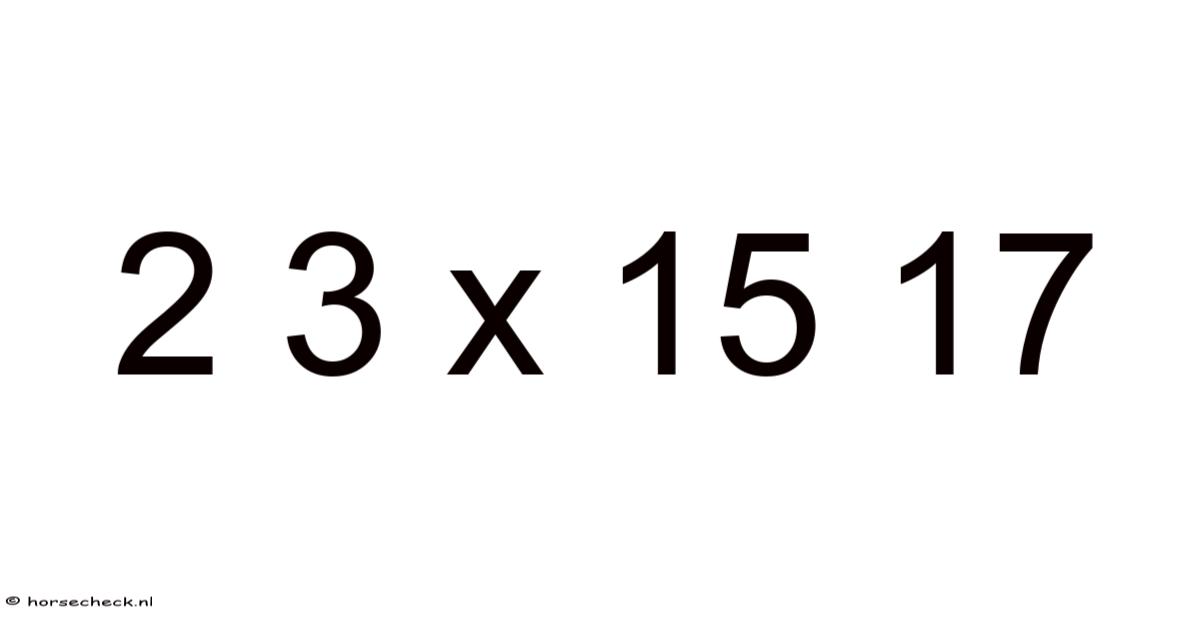
Unveiling the Mysteries of 23 x 1517: A Deep Dive into Multiplication and Beyond
This article breaks down the seemingly simple calculation of 23 multiplied by 1517, exploring not just the answer but the underlying mathematical principles, different methods of calculation, and the broader implications of multiplication in various fields. In real terms, understanding this seemingly basic operation opens doors to a deeper appreciation of mathematics and its practical applications in everyday life and advanced fields. We'll cover various approaches, from basic multiplication to more advanced techniques, making this exploration accessible to everyone, regardless of their mathematical background.
Counterintuitive, but true Simple, but easy to overlook..
Understanding the Fundamentals: Multiplication Basics
Before we tackle 23 x 1517, let's revisit the fundamentals of multiplication. Take this: 3 x 4 means adding 3 four times (3 + 3 + 3 + 3 = 12). While this method works for smaller numbers, it becomes inefficient for larger numbers like the ones in our problem. Multiplication is essentially repeated addition. That's why, we need more efficient methods.
Methods for Calculating 23 x 1517
Several approaches can be used to solve this multiplication problem. Let's explore some of the most common and effective methods:
1. Standard Long Multiplication:
This is the method most commonly taught in schools. It involves multiplying each digit of one number by each digit of the other number, aligning the partial products according to their place value, and then adding them together.
Let's break down 23 x 1517 using long multiplication:
    1517
x      23
---------
    4551  (1517 x 3)
  30340  (1517 x 20)
---------
  34891  (Sum of partial products)
So, 23 x 1517 = 34891.
2. Distributive Property:
The distributive property of multiplication states that a(b + c) = ab + ac. We can use this property to break down the problem into smaller, more manageable parts.
We can rewrite 23 as (20 + 3) and apply the distributive property:
(20 + 3) x 1517 = (20 x 1517) + (3 x 1517)
Calculating each part separately:
20 x 1517 = 30340 3 x 1517 = 4551
Adding the results: 30340 + 4551 = 34891
This method showcases the underlying mathematical principles and can be helpful in understanding the process Less friction, more output..
3. Lattice Multiplication:
Lattice multiplication is a visual method that can be easier to understand for some individuals. Practically speaking, it involves creating a grid, performing individual multiplications within the grid, and then adding diagonally. That said, while it might seem more complex initially, it can be quite efficient for larger numbers. This method is particularly useful for demonstrating the concept of place value in a visual manner. Unfortunately, due to the limitations of this text-based format, a visual representation of lattice multiplication cannot be provided here. Still, readily available online resources can provide detailed explanations and visual examples Not complicated — just consistent. Surprisingly effective..
This is where a lot of people lose the thread That's the part that actually makes a difference..
4. Using a Calculator:
right now, calculators provide a quick and efficient way to perform calculations. Because of that, while they simplify the process, understanding the underlying mathematical concepts remains crucial. Using a calculator, we would simply input "23 x 1517" and obtain the answer: 34891.
The Significance of Multiplication in Various Fields
Multiplication is a fundamental operation with far-reaching implications across diverse fields:
-
Engineering and Physics: Calculations involving forces, velocities, areas, volumes, and many other physical quantities heavily rely on multiplication. Engineers use multiplication to design structures, calculate energy requirements, and model physical phenomena.
-
Finance and Business: Multiplication is essential for calculating profits, losses, interest, taxes, and other financial aspects. Business professionals use it in budgeting, forecasting, and analyzing financial data.
-
Computer Science: Multiplication is a core operation in computer programming and algorithms. It is used in graphics processing, data encryption, and various other computational tasks.
-
Everyday Life: From calculating the total cost of groceries to determining the area of a room, multiplication matters a lot in our daily lives. It helps us with simple tasks and more complex decision-making processes No workaround needed..
-
Statistics and Data Analysis: Multiplication is involved in calculating probabilities, averages, variances, and other statistical measures. It is an integral part of analyzing data and drawing conclusions.
Exploring Beyond the Basics: Factors, Multiples, and Prime Numbers
The calculation of 23 x 1517 provides an opportunity to explore related mathematical concepts:
-
Factors: Factors are numbers that divide evenly into another number without leaving a remainder. To give you an idea, the factors of 23 are 1 and 23 (23 is a prime number). The factors of 1517 are more numerous and require prime factorization to determine.
-
Multiples: Multiples are the products of a number and any integer. To give you an idea, some multiples of 23 are 23, 46, 69, and so on. The number 34891 is a multiple of both 23 and 1517.
-
Prime Numbers: A prime number is a natural number greater than 1 that has no positive divisors other than 1 and itself. 23 is a prime number. Understanding prime factorization (expressing a number as a product of prime numbers) is crucial for various mathematical applications, including cryptography And that's really what it comes down to..
Prime Factorization of 1517
Let's find the prime factorization of 1517:
Through trial division, we find that 1517 is divisible by 37: 1517 ÷ 37 = 41. Both 37 and 41 are prime numbers. So, the prime factorization of 1517 is 37 x 41.
This prime factorization is useful in understanding the divisibility rules and the composition of the number 1517.
Frequently Asked Questions (FAQ)
-
Q: What is the easiest way to calculate 23 x 1517?
- A: The easiest way depends on your familiarity with different methods. For most, a calculator is the quickest. Even so, understanding long multiplication or the distributive property is beneficial for building mathematical skills.
-
Q: Why is multiplication important?
- A: Multiplication is a fundamental operation used extensively across various fields, from simple everyday tasks to complex scientific calculations. It's a cornerstone of mathematics and its applications.
-
Q: What are some real-world applications of this calculation?
- A: While 23 x 1517 might not represent a common real-world scenario directly, it illustrates the principle of multiplication applied in countless situations, such as calculating the total cost of 23 items priced at 1517 each, or finding the area of a rectangle with dimensions related to these numbers.
Conclusion: Beyond the Numbers
The seemingly simple calculation of 23 x 1517 opens a gateway to a broader understanding of multiplication, its underlying principles, and its vast applications. This exploration highlights the interconnectedness of mathematical concepts and their importance in various aspects of our lives and our world. By exploring different calculation methods and delving into related mathematical concepts like prime factorization and the distributive property, we can appreciate the power and elegance of mathematics. The answer, 34891, is just the beginning of a much richer and more insightful mathematical journey.
