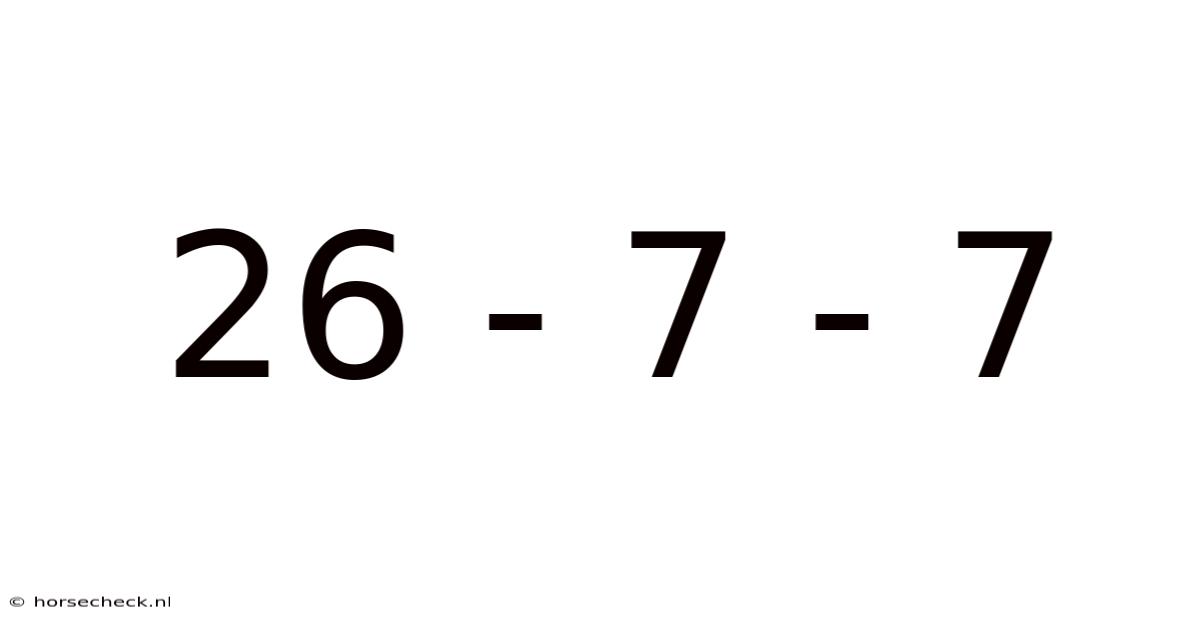
Decoding the Enigma: Understanding the 26-7-7 Code and Its Implications
The cryptic sequence "26-7-7" might initially seem like a random string of numbers. In practice, this article delves deep into the potential meanings and interpretations of this numerical code, exploring its various facets and offering a comprehensive understanding for readers of all backgrounds. Still, depending on the context, it can represent a fascinating intersection of mathematics, cryptography, and even linguistic patterns. Understanding this seemingly simple code requires exploring its potential within different frameworks.
The Mathematical Perspective: Prime Numbers and Divisibility
From a purely mathematical standpoint, the numbers 26, 7, and 7 present several interesting properties. Here's the thing — the number 7, on the other hand, is a prime number itself – meaning it's only divisible by 1 and itself. Both 2 and 13 are prime numbers. 26 is an even number, a composite number (meaning it has factors other than 1 and itself), and can be expressed as 2 x 13. The repetition of 7 adds another layer to this mathematical analysis Not complicated — just consistent. Which is the point..
-
Prime Factorization: Breaking down the numbers into their prime factors reveals a simple structure: 26 = 2 x 13, and 7 remains 7. This could be relevant in cryptographic applications, particularly in scenarios where prime numbers are crucial. The inclusion of the prime number 7, twice, might indicate a potential for enhanced security or complexity within a code.
-
Modular Arithmetic: Within the realm of modular arithmetic (clock arithmetic), these numbers could represent specific positions or cycles within a larger system. Take this: in a system using modulo 26 (representing the 26 letters of the alphabet), the numbers could indicate shifts or transformations applied to a given sequence. The repeated 7 could signify a specific repetitive operation or a key element in a more extensive algorithm.
-
Number Theory Connections: Further exploration might involve investigating the relationships between these numbers based on number theory concepts like greatest common divisors, least common multiples, or even more advanced mathematical ideas. The relative primality (or lack thereof) between the numbers could be indicative of certain mathematical properties and structures Easy to understand, harder to ignore..
Cryptographic Implications: Ciphers and Codes
The sequence "26-7-7" immediately evokes thoughts of cryptography, particularly substitution ciphers. The number 26 strongly suggests a connection to the 26 letters of the English alphabet, indicating that this sequence might be a key for encrypting or decrypting a message And that's really what it comes down to..
-
Caesar Cipher Variations: A basic Caesar cipher involves shifting each letter in the alphabet by a fixed number of positions. The "7" in "26-7-7" could represent the shift value, while the "26" might simply denote the alphabet's size. A double shift (indicated by the repeated 7) could indicate a more complex cipher variant Most people skip this — try not to..
-
Vigenère Cipher and Polyalphabetic Substitution: More sophisticated ciphers like the Vigenère cipher use polyalphabetic substitution. The numbers could represent different key values for multiple alphabets, each shifting letters based on the key. The combination of 26 (alphabet size) and 7 (shift) creates possibilities for multiple variations of this type of encryption Small thing, real impact. Surprisingly effective..
-
Advanced Cryptographic Applications: Although this sequence is simple, it could serve as a basis for more complex cryptographic operations. To give you an idea, the numbers could be part of a larger key or incorporated within a more sophisticated algorithm that uses prime factorization, modular arithmetic, or other mathematical principles to generate a unique encryption key And that's really what it comes down to..
Linguistic and Pattern Recognition: Beyond the Numbers
Stepping away from purely mathematical interpretations, let's consider whether "26-7-7" might be related to linguistic patterns or other symbolic representations.
-
Letter Frequency Analysis: The number 26 might point towards an analysis of letter frequency in a text, and the "7-7" might signify specific positions or patterns within that analysis. Here's one way to look at it: it might represent the seventh most and second seventh most frequent letters in a specific corpus Worth keeping that in mind. Which is the point..
-
Code-Breaking Strategies: In the realm of cryptanalysis, analyzing the sequence might provide clues to reach a hidden message. The repeated 7 might indicate a particular pattern or a symmetry in the encoding process.
-
Symbolic Interpretations: While less likely, the sequence might have symbolic meaning in a specific context. As an example, in a work of fiction, the numbers could carry a deeper meaning unique to the story's narrative Not complicated — just consistent..
Further Exploration and Possibilities
The interpretation of "26-7-7" is multifaceted and depends heavily on the context. Further investigation might reveal its significance within specific fields:
-
Computer Science: Within computer science, the numbers could represent memory addresses, data structures, or indices within algorithms. The repetition of 7 could suggest a particular iterative process or pattern within a software program But it adds up..
-
Data Analysis: The sequence could be part of a larger dataset, representing specific data points or variables with inherent connections. Understanding the context of the data is key to interpreting the significance of these numbers.
-
Game Theory and Puzzles: "26-7-7" might represent coordinates, codes, or steps involved in solving a complex puzzle or game. Its significance would heavily rely on the rules and mechanisms defined by the game.
Frequently Asked Questions (FAQs)
Q: Is "26-7-7" a known code in any established cryptographic system?
A: Not in any widely known, publicly documented cryptographic system. On the flip side, it can serve as a component or a basis for a custom cipher.
Q: Could this sequence be related to any historical ciphers or codes?
A: While unlikely to be directly related to a historically famous cipher, the principles involved (using numerical sequences as keys) are certainly relevant to many historical cryptographic methods That alone is useful..
Q: What is the most likely interpretation of "26-7-7"?
A: Without more context, it's impossible to determine the most likely interpretation. The possibilities range from simple substitution ciphers to more complex cryptographic algorithms or even purely mathematical relations. The context of its discovery is crucial for interpretation.
Q: How can I decipher a message potentially encrypted using "26-7-7"?
A: Attempting to decipher a message requires more information. If you suspect a substitution cipher, trying different shift values (potentially incorporating the 7 and its repetition) is a starting point. More complex ciphers would require more sophisticated analytical techniques.
Conclusion: The Intrigue of the Unknown
The seemingly simple sequence "26-7-7" opens up a world of possibilities. But while a definitive answer to its meaning remains elusive without further context, exploring its potential interpretations highlights the fascinating interplay between numbers, codes, and the human quest for understanding hidden patterns. Its interpretation spans various disciplines, from pure mathematics to cryptography and linguistics. And the beauty lies in the mystery, prompting further investigation and encouraging a deeper appreciation for the detailed connections within seemingly disparate fields of knowledge. The code, in its simplicity, remains a powerful symbol of the vast potential hidden within even the smallest of numerical sequences.
