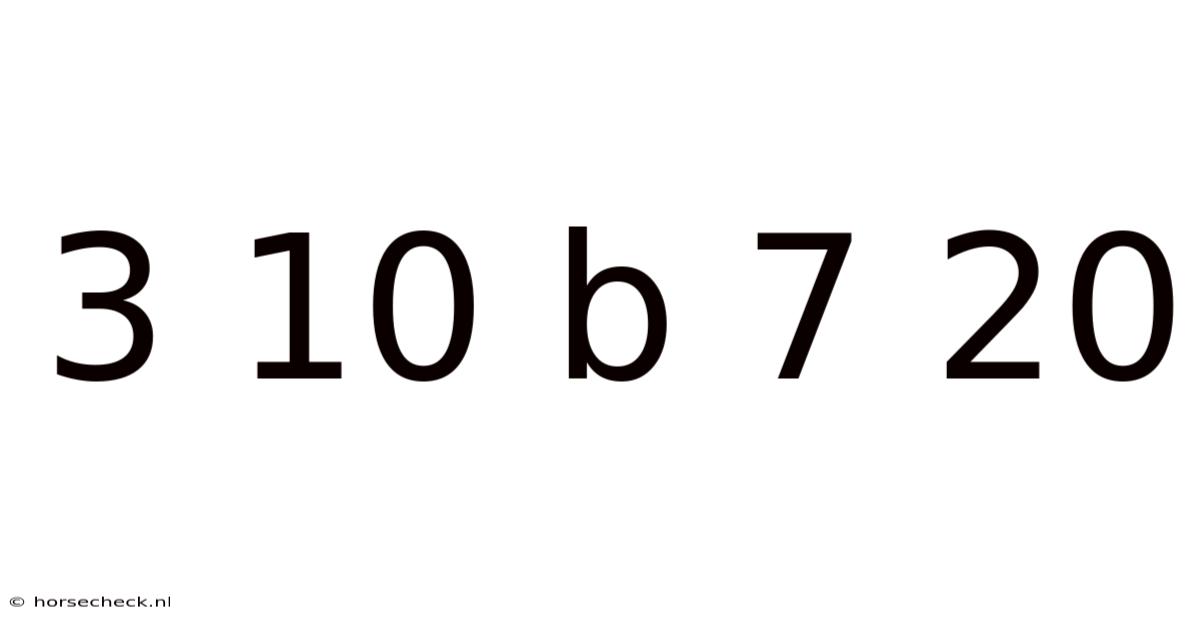
Decoding the Mysterious Sequence: 3 10 b 7 20 – A Journey into Pattern Recognition and Mathematical Reasoning
The sequence "3 10 b 7 20" presents a fascinating puzzle, inviting us to explore the world of pattern recognition and mathematical reasoning. At first glance, it appears random. That said, by systematically analyzing the numbers and the inclusion of the variable 'b', we can uncover potential underlying patterns and logical structures. Day to day, this article delves deep into various approaches to decipher this sequence, exploring different mathematical concepts and highlighting the importance of logical deduction in problem-solving. Understanding this seemingly simple sequence will equip you with valuable skills in critical thinking and analytical problem-solving And it works..
It sounds simple, but the gap is usually here.
Understanding the Problem: Initial Observations and Assumptions
Before we embark on solving this puzzle, let's acknowledge the inherent ambiguity. The sequence, as presented, is incomplete, with 'b' representing an unknown value. This lack of information necessitates a more explorative approach, considering multiple possibilities and employing different problem-solving strategies And it works..
Our initial observations reveal a seemingly arbitrary arrangement of numbers. In practice, there's no immediately obvious arithmetic progression or geometric sequence. And the presence of 'b' suggests that a deeper understanding of the underlying pattern is required before we can determine its value. We can't assume a simple linear relationship between consecutive numbers But it adds up..
- Arithmetic Progression with a Variable Difference: The difference between consecutive numbers might not be constant but could follow a pattern involving the unknown 'b'.
- Geometric Progression with a Variable Ratio: Similar to arithmetic progressions, the ratio between consecutive numbers could follow a pattern incorporating 'b'.
- Polynomial Relationships: The sequence could be generated by a polynomial function, where each term is a result of substituting a corresponding value into the function.
- Recursive Relationships: Each term in the sequence might be defined based on the preceding terms, incorporating 'b' in the recursive formula.
- Combinatorial or Modular Arithmetic: More complex mathematical structures like combinatorics or modular arithmetic could be involved.
Exploring Potential Patterns: Different Approaches
Let's examine several approaches to decipher the sequence and determine the value of 'b' Small thing, real impact..
1. Analyzing Differences and Ratios:
Let's examine the differences between consecutive known numbers:
- 10 - 3 = 7
- 7 - b = (7 - b)
- 20 - 7 = 13
The differences don't immediately reveal a clear pattern. Similarly, let's examine the ratios:
- 10 / 3 ≈ 3.33
- 7 / 10 = 0.7
- 20 / 7 ≈ 2.86
Again, no obvious pattern emerges. The absence of a consistent difference or ratio suggests that a more complex relationship might be at play.
2. Investigating Polynomial Relationships:
We can explore the possibility of a polynomial relationship. Let's assume the sequence is generated by a quadratic equation of the form: an² + bn + c, where 'n' represents the position of the term in the sequence (1, 2, 3, 4, 5) Easy to understand, harder to ignore..
If we substitute the known values (n=1, value=3; n=2, value=10; n=4, value=7; n=5, value=20), we obtain a system of four equations with three unknowns (a, b, c). That said, this system is overdetermined, meaning there might not be a unique solution. Solving this system might yield an approximation, or it could indicate that a quadratic relationship is not the underlying pattern. Higher-order polynomials could also be explored, but the complexity increases significantly Worth knowing..
3. Exploring Recursive Relationships:
A recursive approach assumes each term is defined based on the preceding terms. Let's consider a simple example: a recursive formula involving addition or subtraction. For example:
a(n) = a(n-1) + f(n-1)wheref(n)is some function ofninvolving 'b'.
This approach allows for flexibility and the incorporation of 'b' into the recursive formula. Still, finding the correct function f(n) that fits the given sequence requires careful consideration and trial and error. Various recursive formulas can be tested, adjusting the function f(n) until a pattern emerges that consistently generates the known values And it works..
4. Considering Combinatorial or Modular Arithmetic:
More advanced mathematical concepts could be at play. Combinatorial arrangements or modular arithmetic might be underlying principles. These methods usually involve more layered relationships and might require knowledge of specific mathematical theorems and properties. The sequence's short length makes it difficult to definitively conclude whether these complex methods are necessary Simple, but easy to overlook..
The Importance of Context and Additional Information
The inherent ambiguity of the sequence highlights the importance of context. Without additional information, determining the precise pattern and the value of 'b' remains challenging. If this sequence is part of a larger problem, context clues within the broader problem statement might reveal the underlying principle.
- Is this a code? The sequence might represent a code or cipher where 'b' is a letter representing a specific number.
- Is this a puzzle within a specific game or application? Understanding the rules and mechanics of the game could reveal how the sequence functions.
- Is there a mathematical relationship hinted at elsewhere? The problem might provide other hints or equations relevant to the underlying mathematical principle.
Knowing the source of this sequence is crucial to unlocking its meaning The details matter here..
Developing a Systematic Approach: Strategies for Solving Number Sequences
Solving number sequences, particularly those with ambiguities like this one, requires a systematic and logical approach. Here’s a structured approach:
- Examine the Sequence Carefully: Note any patterns or relationships between consecutive numbers or groups of numbers. Calculate differences, ratios, and look for repeating patterns.
- Consider Different Mathematical Concepts: Explore arithmetic, geometric, polynomial, and recursive relationships. Don't limit yourself to one approach.
- Formulate Hypotheses: Develop specific mathematical expressions that could generate the sequence, including the unknown 'b'.
- Test and Refine Hypotheses: Substitute known values into your hypotheses. If the results don't match the sequence, adjust or discard your hypothesis.
- Seek Additional Information: If possible, look for more context. Where did this sequence come from? Is there related information that can help solve the puzzle?
- Document Your Work: Keep track of your steps, calculations, and hypotheses to avoid repeating errors and track your progress.
Conclusion: The Value of Logical Reasoning and Problem Solving
The sequence "3 10 b 7 20" serves as an excellent example of how seemingly simple problems can require sophisticated problem-solving techniques. But through careful observation, logical deduction, and a systematic exploration of different mathematical methods, we can approach puzzles like this one with confidence and develop valuable analytical skills applicable to various domains. On top of that, while we can’t definitively solve for ‘b’ without further information, the process of attempting to do so demonstrates the power of mathematical reasoning and the value of persistence in problem-solving. And the absence of a readily apparent pattern encourages exploration of various mathematical concepts, highlighting the importance of logical reasoning and systematic approaches. The ambiguity surrounding 'b' underscores the significance of seeking additional context and carefully considering multiple potential solutions. Remember, the journey of exploration and discovery is often as valuable as the final solution.
You'll probably want to bookmark this section.
