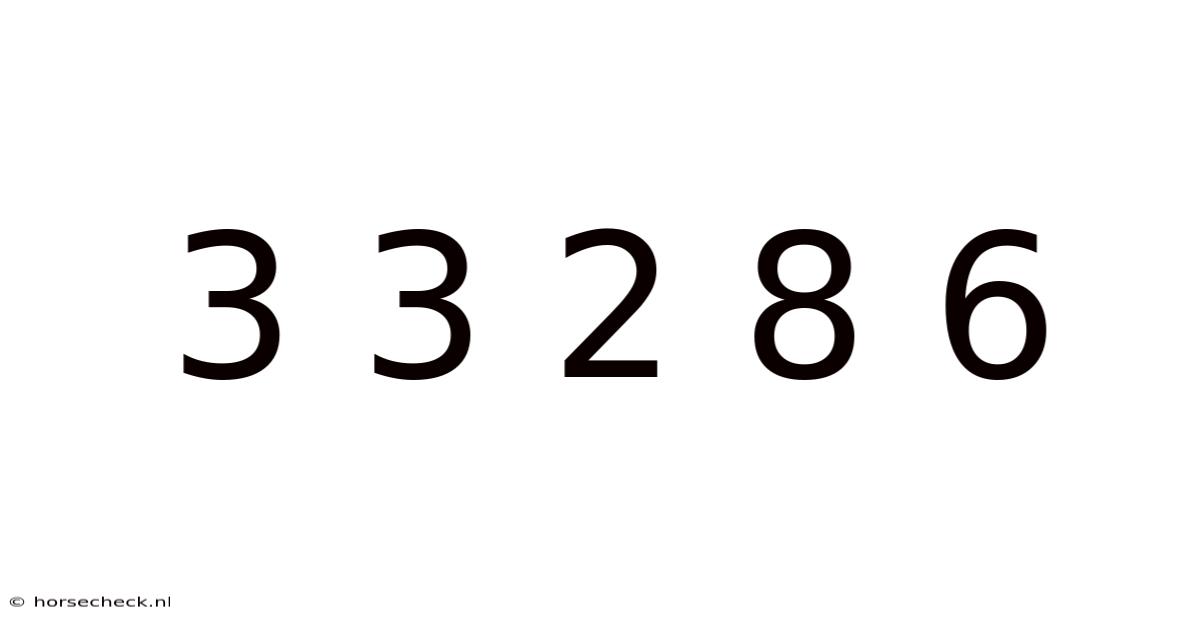
Decoding the Mysterious Sequence: 3 3 2 8 6 – A Deep Dive into Pattern Recognition and Mathematical Possibilities
The seemingly simple sequence "3 3 2 8 6" might appear innocuous at first glance. That said, this short string of numbers presents a fascinating challenge: deciphering the underlying pattern and exploring the myriad mathematical possibilities it represents. Day to day, this article breaks down various approaches to understanding this sequence, exploring different mathematical concepts and demonstrating how seemingly random numbers can hold hidden structure. We'll examine pattern recognition techniques, consider potential generating functions, and discuss the limitations of determining a single "correct" answer Practical, not theoretical..
Understanding Pattern Recognition
The first step in decoding any numerical sequence is applying pattern recognition techniques. We look for relationships between consecutive numbers, differences between them, and potential mathematical operations that could generate the sequence. Let's analyze the given sequence: 3, 3, 2, 8, 6.
- Differences: The differences between consecutive numbers are: 0, -1, 6, -2. This doesn't immediately reveal a clear pattern.
- Ratios: The ratios between consecutive numbers are: 1, 2/3, 4, 3/4. Again, no obvious pattern emerges.
- Sums: The sums of consecutive pairs are: 6, 5, 10, 14. This also lacks a readily discernible pattern.
The lack of an immediately apparent pattern suggests we may need to explore more sophisticated methods. Perhaps the sequence isn't based on a simple arithmetic or geometric progression Simple as that..
Exploring Potential Mathematical Operations
Let's consider more complex mathematical operations that could generate the sequence.
-
Polynomial Functions: Could a polynomial function generate this sequence? We could use interpolation techniques to find a polynomial that passes through the points (1,3), (2,3), (3,2), (4,8), (5,6). Still, this approach would likely produce a high-degree polynomial, which may not be a meaningful representation of an underlying pattern. A higher-order polynomial would overfit the data, making it unreliable for predicting future terms.
-
Recurrence Relations: A recurrence relation defines each term in the sequence based on previous terms. Finding a recurrence relation for this sequence would require considerable trial and error, and there's no guarantee a simple, elegant solution exists. We could try various combinations of addition, subtraction, multiplication, and division involving previous terms, but the complexity increases rapidly.
-
Modular Arithmetic: Exploring modular arithmetic could reveal hidden cyclical patterns. That said, without more terms in the sequence, it's difficult to determine if such a pattern exists Nothing fancy..
-
Prime Numbers and Divisibility: While the numbers themselves aren't directly related to prime numbers, we could investigate if their factors or divisibility properties reveal a pattern. For example:
- 3: Factors are 1 and 3.
- 3: Factors are 1 and 3.
- 2: Factors are 1 and 2.
- 8: Factors are 1, 2, 4, and 8.
- 6: Factors are 1, 2, 3, and 6.
Again, no immediately obvious pattern is revealed through this approach Easy to understand, harder to ignore..
The Importance of Context and Additional Information
The crucial point to remember is that without further context or information, determining the "correct" pattern for this sequence is highly subjective. The sequence, as presented, is too short to definitively identify a unique generating function or rule. It's entirely possible that this sequence is:
Honestly, this part trips people up more than it should Most people skip this — try not to..
- A fragment of a larger sequence: The given numbers may be a subset of a much longer sequence that reveals a clearer pattern once more terms are included.
- Arbitrary: The sequence could be entirely random, with no underlying mathematical structure whatsoever.
- Part of a code or cipher: The sequence might represent a coded message or a specific set of instructions within a larger system.
The ambiguity inherent in the problem highlights the importance of context when interpreting numerical sequences. Additional information, such as the source of the sequence, its intended purpose, or any accompanying instructions, would significantly aid in determining its underlying structure.
Considering Alternate Interpretations
Beyond purely mathematical approaches, we should consider alternative interpretations:
- Base Conversion: Could the sequence represent numbers in different bases? While unlikely given the limited range of numbers, it's worth briefly considering.
- Coordinate System: Could the sequence represent coordinates in a two-dimensional or three-dimensional space? This would require additional information to define the coordinate system.
- Musical Notation: While highly speculative, the sequence could, in theory, represent musical notes or rhythms. This interpretation requires a defined mapping between numbers and musical elements.
The Limitations of Pattern Recognition
It's vital to acknowledge the limitations of pattern recognition. Consider this: our brains are naturally predisposed to find patterns, even where none exist. This can lead to confirmation bias, where we interpret data to fit our preconceived notions. Still, a short sequence like "3 3 2 8 6" is particularly susceptible to this phenomenon. Multiple patterns could potentially "fit" the data, leading to ambiguity Not complicated — just consistent..
The Power of Hypothesis Testing
A more rigorous approach involves formulating hypotheses about the sequence's generating function and then testing these hypotheses against the available data. This involves:
- Formulating a Hypothesis: Propose a potential rule or pattern that might generate the sequence.
- Predicting Future Terms: Use the hypothesized rule to predict the next few terms in the sequence.
- Testing the Hypothesis: Compare the predicted terms with additional data (if available) to assess the accuracy of the hypothesis.
- Refining the Hypothesis: If the hypothesis is inaccurate, refine it based on the discrepancies and repeat the process.
Conclusion: The Ambiguity of Limited Data
The sequence "3 3 2 8 6" presents a fascinating illustration of the challenges and ambiguities inherent in pattern recognition. That's why without additional information or context, it's impossible to definitively determine the underlying pattern. The analysis presented here highlights the importance of considering various mathematical approaches and acknowledging the limitations of drawing conclusions from limited data. The exploration has served to demonstrate that seemingly simple sequences can conceal surprising depths, requiring creativity, critical thinking, and a healthy dose of skepticism to unravel their mysteries. The true power lies not in finding a single "correct" answer but in the process of exploration and critical analysis itself. The journey to understanding this sequence underscores the complexities and nuances of mathematical pattern recognition Took long enough..
