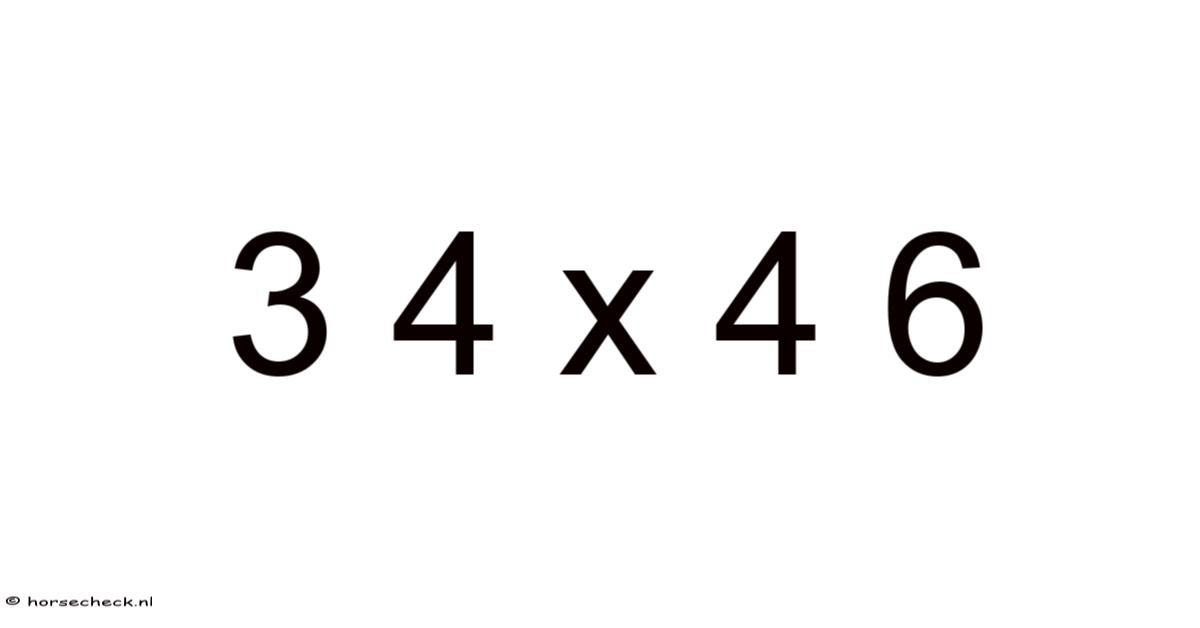
Decoding the Mystery: Exploring the Mathematical Significance of 3, 4, 4, 6
This article digs into the intriguing sequence 3, 4, 4, 6, exploring its potential mathematical interpretations and significance. Still, while this specific sequence doesn't represent a widely recognized established mathematical constant or theorem, its exploration allows us to dig into various mathematical concepts, highlighting the beauty and complexity hidden within seemingly simple numerical arrangements. We will explore different perspectives, from basic arithmetic to more advanced concepts, offering a comprehensive look at the possible meanings and implications of this sequence.
I. Initial Observations and Interpretations
At first glance, the sequence 3, 4, 4, 6 seems arbitrary. That said, we can start by examining basic mathematical properties:
-
Arithmetic Progression: The sequence isn't an arithmetic progression (a sequence with a constant difference between consecutive terms). The differences between consecutive terms are 1, 0, and 2, showing no consistent pattern Simple, but easy to overlook..
-
Geometric Progression: Similarly, it's not a geometric progression (a sequence with a constant ratio between consecutive terms). The ratios are 4/3, 1, and 6/4 (or 3/2), lacking a consistent value And that's really what it comes down to..
-
Fibonacci-like Sequences: While it doesn't directly follow the Fibonacci sequence (where each term is the sum of the two preceding terms), it could potentially be related to a modified or generalized Fibonacci-like sequence. On the flip side, finding a consistent rule for generation remains challenging.
-
Prime Numbers and Composites: The sequence contains both prime numbers (3) and composite numbers (4, 4, 6). This observation doesn't reveal an immediate pattern but highlights the interplay between different number types.
II. Exploring Potential Mathematical Frameworks
Let's consider some broader mathematical contexts in which this sequence might find relevance:
A. Combinatorics and Permutations:
We can interpret the sequence as representing counts or quantities within a specific combinatorial problem. For example:
-
Imagine a scenario with three objects of type A, four objects of type B, four objects of type C, and six objects of type D. This sequence could represent the number of each object type in a collection Not complicated — just consistent..
-
Consider arrangements or permutations of these objects. The number of distinct permutations would depend on the specific constraints or arrangements. This context offers a potential meaning for the sequence, linking it to the field of combinatorics Most people skip this — try not to..
B. Graph Theory and Network Analysis:
The sequence could represent characteristics of a graph or network:
-
Degrees of Nodes: Each number in the sequence could represent the degree (number of connections) of a node in a graph. A graph with nodes having degrees 3, 4, 4, and 6 could be constructed. Analyzing the properties of this graph (connectivity, paths, cycles) might reveal underlying patterns or insights related to the sequence Nothing fancy..
-
Network Structures: The sequence might also represent certain network structures such as the number of connections in different layers of a hierarchical network or a complex system Small thing, real impact..
C. Number Theory and Modular Arithmetic:
Exploring the sequence through the lens of number theory might offer deeper insights:
-
Prime Factorization: The prime factorization of each number in the sequence (3 = 3, 4 = 2², 6 = 2 x 3) shows a mix of prime factors (2 and 3). Investigating the relationships between these prime factors might uncover patterns.
-
Modular Arithmetic: Examining the remainders when each number is divided by a specific modulus (e.g., modulo 3, modulo 4, modulo 5) could reveal hidden patterns or congruences.
III. Generating Functions and Sequences
In advanced mathematics, generating functions provide a powerful tool to analyze sequences. While finding a simple, closed-form generating function for 3, 4, 4, 6 might be difficult, we can explore the possibility of constructing a generating function that incorporates the sequence. This would involve finding a function whose coefficients match the terms of the sequence. This approach, however, requires advanced mathematical techniques But it adds up..
Some disagree here. Fair enough Not complicated — just consistent..
IV. Statistical Analysis and Probability
From a statistical perspective, the sequence is too short to draw any meaningful statistical conclusions. Even so, if the sequence were extended or considered as part of a larger dataset, statistical analysis techniques like regression analysis or time series analysis could potentially reveal underlying trends or relationships. Statistical measures such as mean, median, and standard deviation could be calculated, but their significance would be limited given the short length of the sequence Surprisingly effective..
V. Geometric Interpretations
While the sequence doesn't directly represent well-known geometric shapes or figures, we could consider abstract geometrical representations. For instance:
-
Polygons: The numbers could represent the number of sides in polygons (a triangle, quadrilateral, quadrilateral, hexagon). Exploring relationships between these polygons (areas, angles, symmetries) might offer insights And it works..
-
Tessellations: The sequence could represent the number of tiles or elements in a specific tessellation or tiling pattern.
VI. Connecting to Other Mathematical Fields
The sequence could potentially be linked to other mathematical fields, such as:
-
Abstract Algebra: The sequence could be explored within the context of algebraic structures like groups, rings, or fields. As an example, considering the sequence as elements within a specific group and analyzing their operations could reveal inherent properties Simple, but easy to overlook..
-
Fractal Geometry: Although not immediately apparent, the sequence might be related to fractal patterns or dimensions. Further investigation into the generation and properties of fractals might uncover connections.
VII. The Importance of Context
The significance of the sequence 3, 4, 4, 6 heavily depends on the context. Without additional information or a specific problem statement, assigning a definitive mathematical meaning is challenging. The sequence could represent various quantities, measurements, or characteristics depending on the underlying problem or scenario.
VIII. Expanding the Exploration
To further explore the significance of the sequence, we could consider:
-
Extending the Sequence: If the sequence is part of a larger, yet unknown, sequence, extending it could provide valuable clues for identifying patterns or relationships.
-
Looking for Underlying Rules: Intensive investigation into potential mathematical rules or algorithms that could generate this sequence should be explored.
-
Computational Approaches: Computational methods like computer simulations or algorithms could help explore potential relationships or patterns that might be difficult to identify manually But it adds up..
IX. Conclusion: A Journey of Mathematical Exploration
While the sequence 3, 4, 4, 6 doesn't represent a known mathematical constant or theorem, its exploration opens up avenues to explore various mathematical concepts and their interconnectedness. From basic arithmetic operations to advanced techniques in combinatorics, graph theory, and number theory, the sequence serves as a catalyst for deeper mathematical investigation. The journey of exploring this seemingly simple sequence highlights the richness and complexity within the mathematical world, emphasizing the importance of context and the endless possibilities for discovery. The lack of an immediate, obvious meaning underscores the creative potential within mathematics, inviting further exploration and the potential discovery of new connections and insights. The true significance lies not just in finding a definitive answer, but in the process of mathematical inquiry itself.
