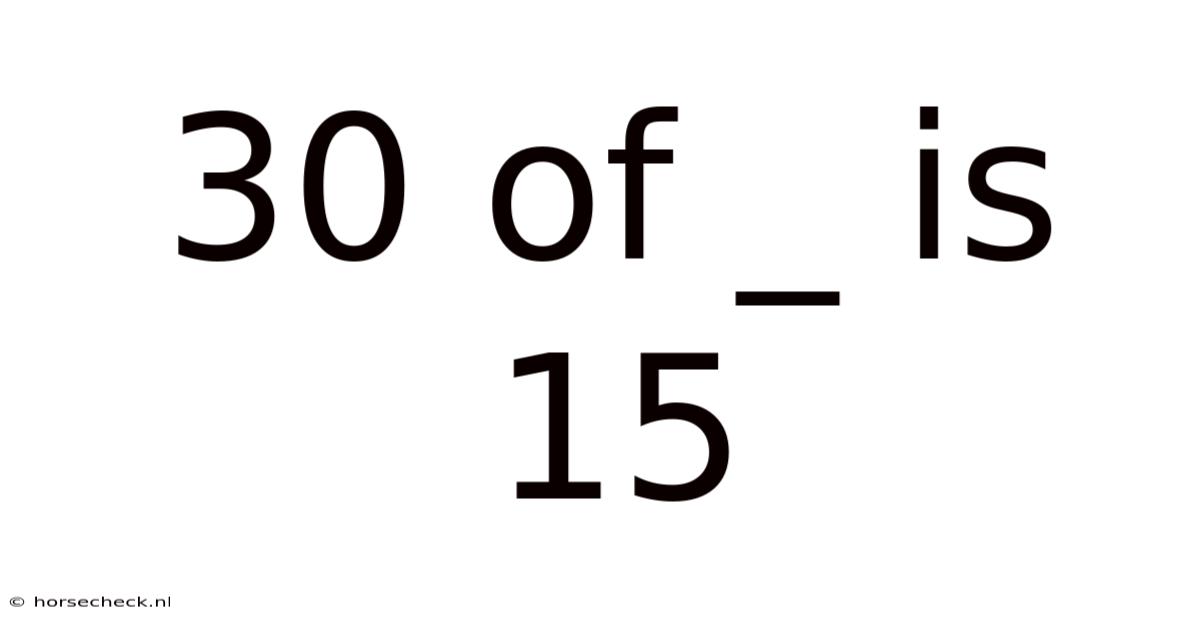
30% of is 15: Understanding Percentages and Solving Real-World Problems
Finding a specific percentage of a number is a fundamental skill used daily in various contexts – from calculating discounts and sales tax to understanding financial reports and analyzing data. But we'll explore different methods for solving this type of percentage problem, covering both the formulaic approach and intuitive methods, ensuring you gain a solid understanding of percentages and their practical applications. This article will get into the seemingly simple problem, "30% of what is 15?Even so, ", explaining the process step-by-step and illustrating how to apply this concept to broader mathematical and real-world scenarios. This guide is designed for learners of all levels, from those just starting to understand percentages to those looking to refresh their knowledge and improve their problem-solving skills.
Understanding the Fundamentals: Percentages and Proportions
Before diving into the solution, let's solidify our understanding of percentages. A percentage represents a fraction of 100. Still, for example, 30% means 30 out of 100, or 30/100, which simplifies to 3/10. This understanding is crucial for solving percentage problems. The core concept behind percentage problems involves proportions.
- Part/Whole = Percentage/100
In our problem, "30% of what is 15?", we know the percentage (30%) and the part (15). The "what" represents the whole, which is the unknown we need to find.
Method 1: Using the Formula
The most straightforward approach to solving "30% of what is 15?" involves using the percentage formula directly. We can represent the problem algebraically:
- 0.30 * x = 15
Where:
- 0.30 represents 30% (converted to decimal form by dividing by 100)
- x represents the unknown whole number
- 15 represents the known part
To solve for x, we isolate the variable by dividing both sides of the equation by 0.30:
- x = 15 / 0.30
- x = 50
So, 30% of 50 is 15 Turns out it matters..
Method 2: Setting up a Proportion
Another effective method utilizes proportions, directly applying the concept mentioned earlier: Part/Whole = Percentage/100. Let's substitute the known values:
- 15/x = 30/100
Now, we can cross-multiply to solve for x:
- 15 * 100 = 30 * x
- 1500 = 30x
Dividing both sides by 30:
- x = 1500 / 30
- x = 50
Again, we find that 30% of 50 is 15. This method visually emphasizes the proportional relationship between the part, the whole, and the percentage.
Method 3: Using the Concept of "One Percent"
This method involves finding the value of 1% first, then scaling it up to find the whole. If 30% of a number is 15, then 1% would be:
- 15 / 30 = 0.5
Since 1% is 0.5, to find 100% (the whole), we multiply by 100:
- 0.5 * 100 = 50
That's why, the whole number is 50. This approach provides a clear understanding of the relationship between different percentages of a number That's the whole idea..
Applying Percentage Calculations to Real-World Scenarios
Understanding how to solve "30% of what is 15?" translates directly to numerous real-life situations. Consider these examples:
-
Sales and Discounts: A store offers a 30% discount, and an item costs $15 after the discount. What was the original price? This is directly analogous to our problem; the original price is 50.
-
Tax Calculations: A sales tax of 30% adds $15 to the price of an item. What's the pre-tax price of the item? Similar to the discount example, the pre-tax price would be 50 Which is the point..
-
Financial Analysis: A company reports that 30% of its total revenue is $15 million. What is the company's total revenue? The answer is $50 million But it adds up..
-
Data Interpretation: In a survey, 30% of respondents answered "yes" to a particular question, and this represents 15 individuals. How many people participated in the survey? The total number of participants is 50 Most people skip this — try not to..
Beyond the Basics: Extending Percentage Calculations
The fundamental principle of solving percentage problems remains consistent regardless of the complexity. Let's explore some variations:
-
Finding a Different Percentage: If you needed to find what 20% of 50 is, you would simply multiply 50 by 0.20, giving you 10.
-
Finding the Percentage: If you want to know what percentage 15 is of 50, you would divide 15 by 50 and multiply by 100: (15/50) * 100 = 30%.
-
Solving for a Different Part: If you knew the whole was 50 and you wanted to find what 40% of it is, you'd multiply 50 by 0.40, resulting in 20.
Frequently Asked Questions (FAQ)
Q: What if the percentage is greater than 100%?
A: If the percentage is greater than 100%, the resulting value will be greater than the original number. 50 = 75). But for instance, 150% of 50 is 75 (50 * 1. This often applies to scenarios involving growth or increase That's the whole idea..
Q: Can I use a calculator for these problems?
A: Absolutely! Calculators significantly simplify the process, especially for more complex percentage problems. Even so, understanding the underlying concepts is crucial, even when using a calculator.
Q: Are there any other methods to solve percentage problems?
A: Yes, depending on the problem's context, various approaches exist, including using ratios, proportions, or even visual representations like pie charts to better grasp the relationship between the parts and the whole Worth keeping that in mind..
Conclusion
Solving "30% of what is 15?And it’s a gateway to understanding and applying percentage calculations in diverse real-world situations. Remember, the key lies not just in finding the answer but in understanding the underlying concepts of percentages and proportions. Practice applying these methods to various scenarios to solidify your understanding and enhance your problem-solving capabilities. That's why by mastering the different methods presented – using the formula, setting up proportions, and employing the "one percent" approach – you equip yourself with a valuable skill set. Think about it: " is more than just a mathematical exercise. The ability to confidently tackle percentage problems empowers you to handle financial decisions, interpret data, and comprehend numerous aspects of daily life with greater clarity and precision.
