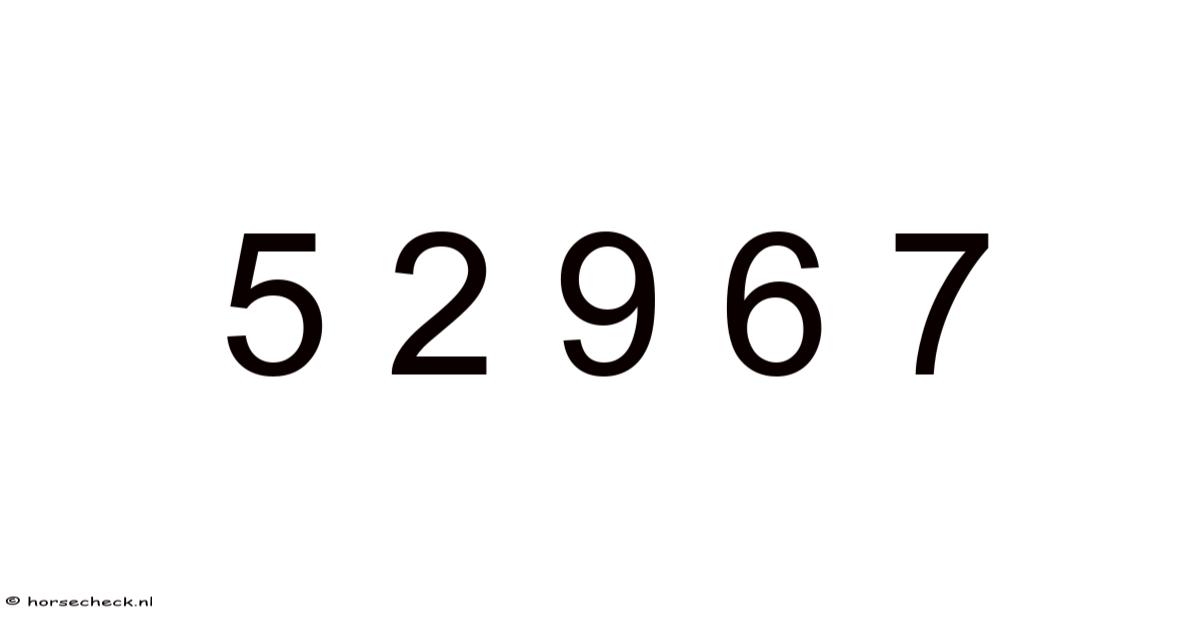
Unlocking the Mysteries of 5 2 9 6 7: A Journey into Number Patterns, Probability, and the Human Imagination
The seemingly simple sequence "5 2 9 6 7" might appear random at first glance. On the flip side, this seemingly insignificant string of digits opens a door to a fascinating exploration of mathematics, probability, and the very nature of pattern recognition within the human mind. In practice, this article delves deep into the potential interpretations of this sequence, exploring its mathematical properties, probabilistic significance, and the role of human perception in assigning meaning to seemingly random data. We will explore various approaches, including exploring potential number patterns, calculating probabilities, and examining the psychological factors that influence our interpretation of numerical sequences.
Easier said than done, but still worth knowing.
Understanding the Limitations: The Absence of Inherent Meaning
Before we walk through potential interpretations, it's crucial to establish a fundamental point: the sequence 5 2 9 6 7, in isolation, possesses no inherent meaning. Unlike a mathematical formula or a coded message with a pre-defined key, this sequence is a collection of digits devoid of inherent structure or significance. Any meaning we ascribe to it is a product of our own interpretation, guided by our mathematical understanding, our biases, and our tendency to seek patterns.
Exploring Potential Number Patterns: A Mathematical Perspective
Let's approach this sequence from a mathematical perspective, examining several potential avenues for finding structure or pattern:
-
Arithmetic Sequences: We can look for differences between consecutive numbers. The differences between successive numbers in 5 2 9 6 7 are -3, 7, -3, 1. There's no immediately apparent arithmetic progression. That said, we could explore higher-order differences or explore variations of arithmetic progressions, though the limited length of the sequence makes this challenging.
-
Geometric Sequences: A geometric sequence involves a constant ratio between consecutive terms. Again, a quick inspection reveals no consistent ratio between the numbers in our sequence.
-
Fibonacci-like Sequences: The Fibonacci sequence (1, 1, 2, 3, 5, 8, 13...) is characterized by each number being the sum of the two preceding ones. While our sequence doesn't directly conform to the Fibonacci pattern, it's possible to explore variations or generalizations of the Fibonacci concept, though the results would be highly speculative without further information or context Simple, but easy to overlook..
-
Modular Arithmetic: We could examine the remainders when these numbers are divided by a particular integer. As an example, dividing each number by 3 yields remainders 2, 2, 0, 0, 1. While there's some repetition, no clear pattern emerges that would definitively explain the sequence.
-
Prime Numbers and Divisibility: Analyzing the prime factorization of each number (5, 2, 9, 6, 7) could offer clues, but again, no obvious pattern emerges from the prime factorizations themselves.
The exploration of these various mathematical approaches highlights the inherent challenge: a short sequence of digits provides limited information, making it difficult to confidently establish a consistent mathematical relationship.
Probability and Randomness: The Statistical Viewpoint
From a probabilistic standpoint, the appearance of randomness is not surprising. Think about it: if we assume each digit is chosen independently and randomly from the set {0, 1, 2, 3, 4, 5, 6, 7, 8, 9}, the probability of observing any specific sequence of five digits is (1/10)^5, or 1 in 100,000. Which means, observing the sequence 5 2 9 6 7 is not particularly improbable from a purely statistical perspective.
That said, the human brain is inherently predisposed to pattern recognition, often to the point of identifying patterns where none exist (apophenia). This is why we may feel compelled to find a hidden meaning or order, even in a random sequence.
The Human Factor: Perception and Pattern Recognition
Our attempts to find meaning in the sequence 5 2 9 6 7 are intrinsically linked to our cognitive biases. The human brain is exceptionally adept at detecting patterns, even subtle ones, as this ability was crucial for survival in our evolutionary past. This inherent tendency can lead to:
-
Confirmation Bias: We may latch onto a pattern that seems plausible, ignoring evidence that contradicts it. If we find a weak correlation, we might tend to overemphasize its significance.
-
Clustering Illusion: We tend to perceive clusters or patterns in random data, even if they are statistically insignificant. This can make us see order where only randomness exists And it works..
-
Pareidolia: This refers to the tendency to perceive meaningful images in random or ambiguous visual patterns. The same cognitive mechanism can apply to numerical sequences, leading us to ascribe meaning where there is none.
These cognitive biases highlight the limitations of relying solely on intuition when analyzing numerical sequences. Objective statistical analysis and rigorous mathematical methods are essential for avoiding misleading interpretations.
Extending the Sequence: Speculative Possibilities
One could speculate about extending the sequence. That said, any extension would be entirely arbitrary without additional context or information. Any continuation would be a guess, not a deduction based on inherent properties of the original sequence Less friction, more output..
Frequently Asked Questions (FAQ)
-
Q: Is there a secret code hidden in 5 2 9 6 7? A: There's no evidence to suggest a hidden code. Any meaning ascribed to this sequence is based on interpretation, not on a pre-defined code or cipher.
-
Q: Could this sequence be related to a mathematical constant? A: While there is no known direct relationship to established mathematical constants, one could perform extensive searches and analyses to check for correlations, though this process may not yield fruitful results Easy to understand, harder to ignore..
-
Q: Could this sequence have significance in a specific field (e.g., cryptography, physics)? A: Without further context or information, it's highly unlikely that the sequence holds any significant meaning within any specific field.
-
Q: Is there a unique "correct" interpretation? A: No. The lack of inherent meaning in the sequence means there is no single "correct" interpretation. Any interpretation is contingent upon the assumptions and frameworks employed in the analysis But it adds up..
Conclusion: The Importance of Critical Thinking
The seemingly innocuous sequence "5 2 9 6 7" serves as a valuable reminder of the interplay between mathematics, probability, and human perception. A critical approach, utilizing rigorous mathematical methods and acknowledging the potential influence of cognitive biases, is necessary when analyzing numerical sequences or any form of data. While our brains are adept at pattern recognition, this very ability can lead to subjective interpretations and biases. This leads to the absence of a clear pattern in 5 2 9 6 7 demonstrates the importance of carefully considering statistical probabilities and avoiding the trap of assigning meaning to purely random data. While the mystery of 5 2 9 6 7 might not be solved in a definitive way, the journey of exploring its potential interpretations has offered a valuable lesson in critical thinking and the limitations of our intuitive understanding Practical, not theoretical..
