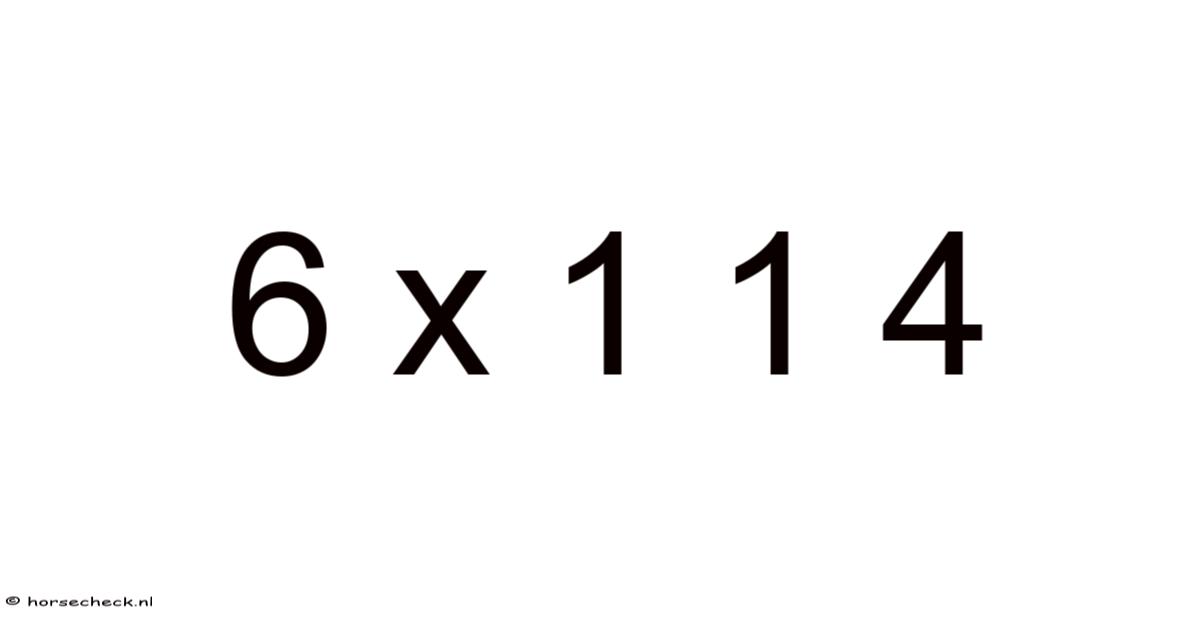
Decoding 6 x 1 1/4: A Deep Dive into Multiplication with Mixed Numbers
This article explores the seemingly simple calculation of 6 x 1 1/4, but goes far beyond a simple numerical answer. Worth adding: we'll get into the fundamental mathematical concepts involved, explore multiple approaches to solving the problem, and examine the broader implications of understanding mixed number multiplication. This practical guide is perfect for students needing to grasp this concept, teachers looking for diverse teaching methods, or anyone curious about the intricacies of arithmetic.
Understanding the Components: Mixed Numbers and Multiplication
Before tackling the problem directly, let's define our key terms. 6 is a whole number, a simple and straightforward unit. 1 1/4 is a mixed number, a combination of a whole number (1) and a fraction (1/4). So the core of this problem lies in understanding how to multiply a whole number by a mixed number. Now, this seemingly simple calculation requires a foundational understanding of fractions and their interaction with whole numbers. Mastering this will pave the way for more complex mathematical operations later on.
Method 1: Converting to Improper Fractions
It's often considered the most straightforward approach. Plus, the first step involves converting the mixed number 1 1/4 into an improper fraction. An improper fraction is a fraction where the numerator (the top number) is larger than or equal to the denominator (the bottom number) Took long enough..
Short version: it depends. Long version — keep reading.
To convert 1 1/4 to an improper fraction:
- Multiply the whole number by the denominator: 1 x 4 = 4
- Add the numerator: 4 + 1 = 5
- Keep the same denominator: The denominator remains 4.
So, 1 1/4 becomes 5/4.
Now, our problem simplifies to: 6 x 5/4. To multiply a whole number by a fraction, we simply multiply the whole number by the numerator and keep the denominator the same:
(6 x 5) / 4 = 30/4
Finally, we simplify the improper fraction 30/4 by dividing both the numerator and denominator by their greatest common divisor, which is 2:
30/4 = 15/2
This improper fraction can then be converted back into a mixed number:
15 ÷ 2 = 7 with a remainder of 1. So, 15/2 = 7 1/2.
So, 6 x 1 1/4 = 7 1/2
Method 2: Distributive Property
Another effective method leverages the distributive property of multiplication. On top of that, this method allows us to break down the mixed number and multiply each part separately. We can rewrite 1 1/4 as 1 + 1/4 But it adds up..
6 x (1 + 1/4)
Using the distributive property, we multiply 6 by each term inside the parentheses:
(6 x 1) + (6 x 1/4) = 6 + 6/4
Simplify 6/4 by dividing both numerator and denominator by 2:
6/4 = 3/2
Now we add the whole number and the fraction:
6 + 3/2
To add these, we convert 6 into a fraction with a denominator of 2:
6 = 12/2
So, 12/2 + 3/2 = 15/2
Converting the improper fraction 15/2 back to a mixed number, we get 7 1/2 Easy to understand, harder to ignore. Less friction, more output..
That's why, 6 x 1 1/4 = 7 1/2
Method 3: Decimal Conversion
A third approach involves converting both numbers to decimals. Here's the thing — 1 1/4 is equivalent to 1. But 25 (since 1/4 = 0. And 6 remains 6. 25).
Now the multiplication becomes:
6 x 1.25 = 7.5
This decimal, 7.5, is equivalent to the mixed number 7 1/2. This method is particularly useful when working with calculators or when dealing with problems involving more complex decimals.
Visualizing the Multiplication: A Practical Approach
Understanding the concept becomes easier with visualization. Imagine you have six pizzas, each cut into four slices (representing the denominator of 1/4). 1 1/4 represents one whole pizza plus one extra quarter of a pizza. Consider this: if you have six of these '1 1/4 pizza' units, you'd have six whole pizzas plus six quarter-pizzas. Six quarter-pizzas is equivalent to 6/4 or 3/2 pizzas, which is 1 and a half pizzas. Adding this to the original six whole pizzas gives you 7 and a half pizzas, or 7 1/2.
The Importance of Understanding Mixed Number Multiplication
The ability to confidently work with mixed numbers is crucial for various applications:
- Everyday Life: From cooking (following recipes with fractional ingredients) to construction (measuring lengths and volumes), mixed numbers are frequently encountered.
- Advanced Mathematics: A strong foundation in mixed number operations is essential for understanding more complex algebraic concepts, equations, and problem-solving.
- STEM Fields: Science, Technology, Engineering, and Mathematics heavily rely on fractional and decimal calculations, making proficiency in mixed number manipulation a necessary skill.
Frequently Asked Questions (FAQ)
- Q: Can I use a calculator to solve this? A: Yes, you can input 6 * 1.25 into a calculator to obtain the decimal answer 7.5, which is equivalent to 7 1/2.
- Q: Why are there multiple ways to solve this? A: Different methods cater to different learning styles and preferences. Some people find visual representations more intuitive, while others prefer the algebraic approach.
- Q: What if the mixed number had a larger fraction part? A: The same principles apply. Convert to an improper fraction, use the distributive property, or convert to decimals—whichever method you find most comfortable.
- Q: Is it always necessary to convert to an improper fraction? A: While converting to improper fractions often simplifies the process, the distributive property provides an alternative that can be equally effective. Choose the method that best suits your understanding.
Conclusion: Mastering Mixed Numbers – A Stepping Stone to Success
Solving 6 x 1 1/4, while seemingly simple, serves as a microcosm of broader mathematical concepts. Plus, understanding mixed numbers and the various methods for multiplying them is crucial for developing strong mathematical skills. Whether you prefer the visual, algebraic, or decimal approach, mastering these techniques opens doors to more complex calculations and solidifies your foundation in mathematics. Remember, the key is to choose the method you find most comfortable and practice consistently. The more you practice, the more confident and proficient you'll become in handling mixed numbers and other mathematical challenges. Through consistent practice and understanding, you can confidently deal with the world of numbers and open up your mathematical potential.
