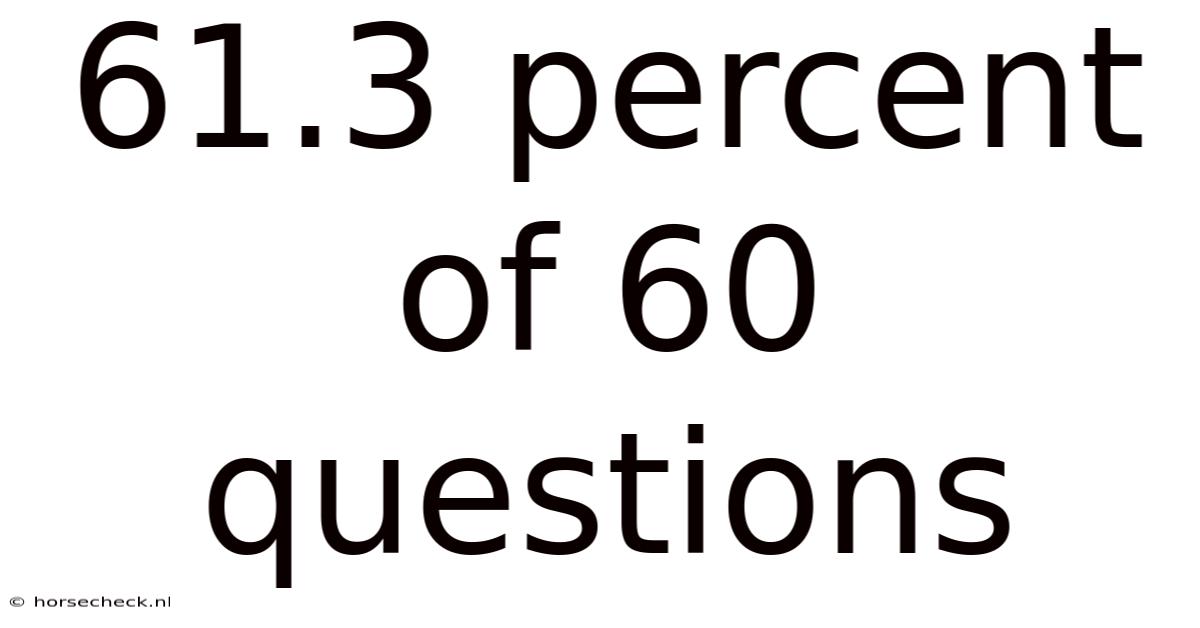
Decoding 61.3% of 60 Questions: A Deep Dive into Percentage Calculations and Their Applications
Calculating percentages is a fundamental skill applicable across numerous fields, from academic assessments to financial analysis and everyday life. That said, this article digs into the specifics of determining 61. 3% of 60 questions, providing a step-by-step guide, exploring different calculation methods, and examining the broader implications of percentage calculations. Understanding this seemingly simple calculation unlocks a deeper understanding of proportional reasoning and its practical applications Still holds up..
Understanding Percentages: A Quick Refresher
A percentage represents a fraction of 100. The term "percent" literally means "out of one hundred.Even so, " Because of this, 61. 3% can be written as 61.Here's the thing — 3/100 or 0. Consider this: 613 in decimal form. Even so, this representation is crucial for performing calculations. To find a percentage of a number, we essentially multiply the number by the decimal equivalent of the percentage.
Calculating 61.3% of 60 Questions: Step-by-Step Guide
The core problem is to find 61.3% of 60. Here's how we can break it down:
-
Convert the percentage to a decimal: Divide 61.3 by 100. This gives us 0.613.
-
Multiply the decimal by the total number of questions: Multiply 0.613 by 60 Most people skip this — try not to..
-
Calculate the result: 0.613 * 60 = 36.78
Which means, 61.3% of 60 questions is 36.78 questions.
Interpreting the Result: The Significance of Decimals
The result, 36.78, presents a slight challenge in interpretation, as we cannot have a fraction of a question. On top of that, in the context of a test or quiz, we need to round the answer. The appropriate rounding method depends on the context And it works..
-
Rounding Down: If we're strictly counting the number of correctly answered questions, we'd round down to 36. This approach is conservative and avoids overestimating performance.
-
Rounding Up: In certain scenarios, rounding up to 37 might be justifiable, especially if the 0.78 represents a partially correct answer or a near miss. This might be appropriate if partial credit is given.
-
Context is Key: The best method depends on how the assessment is scored. If the grading system doesn't allow for partial credit, rounding down is the most accurate Small thing, real impact..
Alternative Calculation Methods
While the method above is straightforward, other approaches can be equally effective:
-
Using Fractions: Express 61.3% as a fraction: 61.3/100. Then, multiply this fraction by 60: (61.3/100) * 60 = 36.78.
-
Using Proportions: Set up a proportion: x/60 = 61.3/100. Solve for x by cross-multiplying: 100x = 60 * 61.3. Then, divide both sides by 100 to find x Still holds up..
These alternative methods offer different perspectives on the same calculation, reinforcing the understanding of proportional relationships.
Practical Applications of Percentage Calculations
Understanding percentage calculations isn't limited to academic exercises; its applications extend far beyond the classroom:
-
Academic Performance: Calculating grades, analyzing test scores, and assessing overall academic progress That's the whole idea..
-
Financial Management: Calculating interest rates, discounts, taxes, profits, and losses. This is crucial for budgeting, investing, and managing personal finances effectively.
-
Data Analysis: Representing data visually using charts and graphs (like pie charts), interpreting survey results, and analyzing market trends.
-
Science and Engineering: Expressing experimental errors, calculating concentrations in chemistry, and analyzing statistical data.
-
Everyday Life: Calculating tips at restaurants, determining discounts during sales, and understanding price increases.
Beyond the Numbers: The Importance of Context and Critical Thinking
While the mechanical process of calculating 61.Now, 3% of 60 is relatively simple, the interpretation and application of the result require critical thinking and an understanding of context. The seemingly small difference between 36 and 37 questions can have significant implications depending on the situation. This highlights the importance of not just knowing how to calculate percentages but also understanding their significance and implications within a given context.
Expanding the Scope: Working with Different Percentages and Numbers
The principles discussed here apply to any percentage calculation. Let's consider some variations:
-
Calculating 85% of 120: Follow the same steps: Convert 85% to 0.85, then multiply by 120 (0.85 * 120 = 102).
-
Finding the percentage one number represents of another: If someone answered 45 questions correctly out of 60, what's their percentage score? Divide the correct answers by the total number of questions and multiply by 100: (45/60) * 100 = 75%.
-
Calculating a percentage increase or decrease: If a value increases from 50 to 60, the percentage increase is calculated as [(60-50)/50] * 100 = 20% Small thing, real impact. But it adds up..
Frequently Asked Questions (FAQ)
Q: Why is it important to understand percentage calculations?
A: Percentage calculations are a fundamental skill with wide-ranging applications in academics, finance, science, and everyday life. Understanding them improves decision-making and problem-solving capabilities Still holds up..
Q: What if the percentage is not a whole number?
A: Even with decimal percentages, the calculation process remains the same. Consider this: convert the percentage to a decimal and multiply. The interpretation of the result might require rounding, based on the specific context Took long enough..
Q: Are there any online tools to help with percentage calculations?
A: While this article focuses on the manual calculation process for a deeper understanding, many online calculators and spreadsheet programs can automate percentage calculations The details matter here..
Q: How can I improve my skills in percentage calculations?
A: Practice is key! Solve various percentage problems with different numbers and percentages. Try using different calculation methods to reinforce your understanding.
Conclusion: Mastering Percentages for a Brighter Future
Mastering percentage calculations is more than just memorizing formulas; it's about developing a deeper understanding of proportional reasoning and its practical applications. In real terms, 3% of 60 to more complex scenarios, the ability to accurately calculate and interpret percentages is a crucial tool for success in various aspects of life. Because of that, whether you're tackling academic assessments, managing finances, or navigating everyday situations, a strong grasp of percentages equips you with a valuable skillset. From the simple calculation of 61.Remember to always consider the context of the problem when interpreting the results, ensuring your conclusions are both accurate and meaningful.
