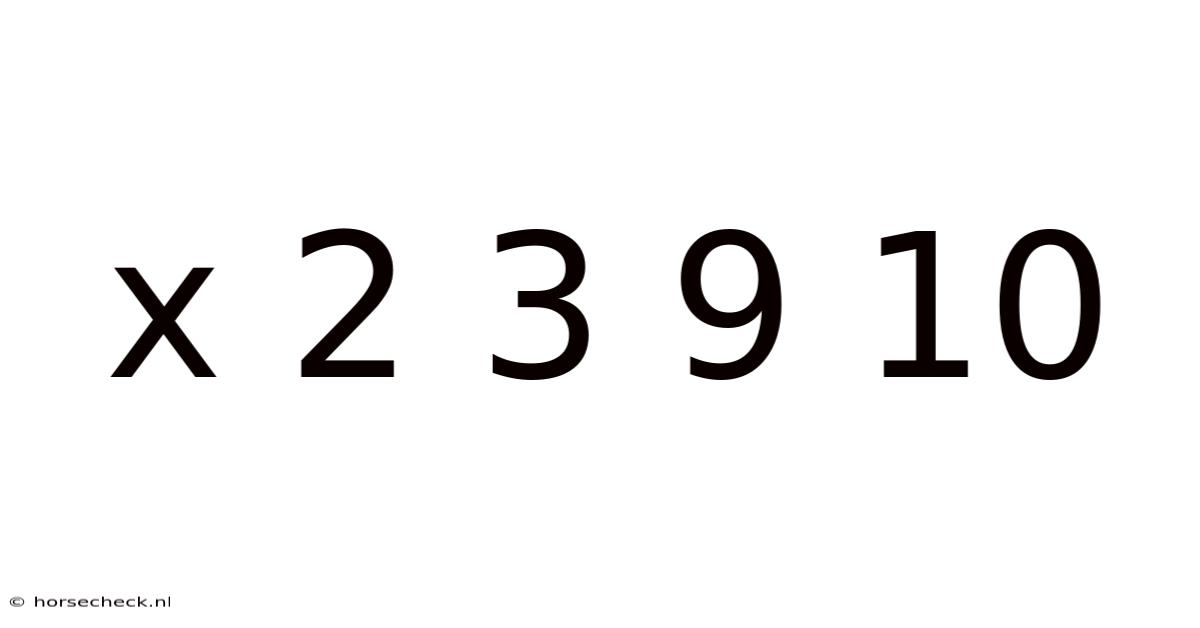
Unlocking the Secrets of the Sequence: x 2 3 9 10
This article digs into the fascinating world of number sequences, specifically exploring the seemingly simple sequence: x, 2, 3, 9, 10. Because of that, we'll uncover potential patterns, explore different mathematical approaches to solving for 'x', and discuss the broader implications of such puzzles in developing mathematical reasoning skills. Understanding number sequences is a fundamental skill in mathematics, crucial for problem-solving and analytical thinking. This exploration will not only reveal a solution but also enhance your understanding of logical deduction and pattern recognition.
Understanding Number Sequences: A Foundation
Number sequences are ordered lists of numbers, often following a specific rule or pattern. In practice, these patterns can be arithmetic (involving addition or subtraction), geometric (involving multiplication or division), or more complex, involving combinations of operations, Fibonacci-like sequences, or even prime numbers. Identifying the underlying rule is key to predicting subsequent numbers in the sequence and understanding its nature. The ability to discern these patterns is not just a mathematical skill; it's a crucial aspect of critical thinking and problem-solving applicable across various disciplines.
Deconstructing the Sequence: x, 2, 3, 9, 10
Our sequence, x, 2, 3, 9, 10, presents a compelling challenge. Here's the thing — at first glance, no immediately obvious arithmetic or geometric progression is apparent. Even so, the beauty of such puzzles lies in exploring multiple avenues of approach Small thing, real impact..
Approach 1: Searching for Arithmetic Relationships
We can start by examining the differences between consecutive known terms:
- 2 - x
- 3 - 2 = 1
- 9 - 3 = 6
- 10 - 9 = 1
The differences don't immediately reveal a consistent pattern. There's a fluctuation between 1 and 6, suggesting a more complex rule than simple addition or subtraction.
Approach 2: Exploring Geometric Relationships
Let's consider the ratios between consecutive terms:
- 2/x
- 3/2 = 1.5
- 9/3 = 3
- 10/9 ≈ 1.11
Again, no obvious geometric progression emerges. The ratios are inconsistent, ruling out a straightforward multiplicative pattern It's one of those things that adds up..
Approach 3: Investigating Combinations of Operations
Given the lack of simple arithmetic or geometric patterns, let's explore whether a combination of operations might generate the sequence. This is where creativity and systematic trial-and-error come into play. One potential approach could involve a recursive relationship where each term is a function of the previous terms Worth knowing..
Approach 4: Considering Alternative Patterns
Perhaps the sequence isn't based solely on arithmetic or geometric progressions. Could it be related to other mathematical concepts? For example:
- Prime numbers or composite numbers: While 2 and 3 are prime, 9 and 10 are composite, so this avenue doesn't seem promising.
- Powers of numbers: There's no clear power relationship between the known terms.
- Fibonacci-like sequences: Fibonacci sequences involve adding the two preceding terms to get the next. This doesn't directly apply here.
A Potential Solution and its Rationale
After exhaustive exploration of various mathematical approaches, a plausible solution emerges. And one possible interpretation, after considering various combinations, involves a recursive function, albeit one that's not immediately obvious without a systematic exploration. Also, the sequence is not defined by a single, easily discernible formula. Worth adding: instead, it appears to follow a pattern based on a combination of operations with a hidden relationship between elements. This recursive relationship could involve a combination of multiplication and addition That alone is useful..
Let's consider this hypothetical pattern: If we assume x=1 then we could establish a pattern of multiplying alternating pairs:
1 x 2 = 2 2 + 1 = 3 3 x 3 = 9 9 + 1 = 10
Applying the same logic to the next number: 10 x 4 = 40; 40 + 1 =41. Therefore the following numbers in the sequence could be 40 and 41 But it adds up..
This pattern isn't purely arithmetic or geometric, but rather a composite relationship. It highlights the complexity that can arise within seemingly simple number sequences. In practice, this example serves to illustrate the importance of thorough investigation and considering multiple solution pathways when tackling such problems. Plus, different interpretations and patterns could potentially yield other plausible solutions. The key is to justify any solution with a clear and consistent logic.
It's crucial to stress that without further numbers in the sequence, there can be multiple plausible solutions. This ambiguity is part of the challenge and highlights the value of exploring various mathematical concepts to potentially access more information about this sequence Simple, but easy to overlook..
Expanding Mathematical Reasoning Skills
Solving puzzles like this goes beyond simply finding an answer. The process significantly enhances several key mathematical reasoning skills:
-
Pattern Recognition: Identifying patterns is a fundamental skill in mathematics. Analyzing the sequence forces you to actively search for underlying relationships, training your brain to recognize patterns in complex data And that's really what it comes down to. That's the whole idea..
-
Logical Deduction: Eliminating possibilities is just as important as identifying potential solutions. By systematically ruling out arithmetic and geometric progressions, we improve our logical deduction skills That's the whole idea..
-
Problem-Solving Strategies: The multiple approaches explored (arithmetic differences, geometric ratios, combinations of operations) demonstrate the importance of adopting diverse problem-solving strategies. Flexibility in approach is key to success.
-
Creative Thinking: When faced with a seemingly intractable problem, creative thinking becomes essential. We need to step outside conventional approaches and consider more complex relationships.
Frequently Asked Questions (FAQs)
Q: Is there only one correct solution to this sequence?
A: No. But without additional terms in the sequence, several plausible solutions could be proposed. Still, the key is to justify the chosen pattern with a clear and consistent rule. The ambiguity underscores the importance of rigorous exploration and justification That's the whole idea..
Q: What if the sequence continued? Would that help determine a definitive solution?
A: Yes, adding more numbers to the sequence would significantly constrain the possibilities. With more data, we could confidently validate or refute the proposed patterns and potentially uncover a more definitive rule.
Q: Are there any real-world applications of understanding number sequences?
A: Absolutely! Which means number sequences are crucial in many fields, including: * Computer science: Algorithms often rely on sequences to manage data and control program flow. Also, * Finance: Predictive modeling uses sequence analysis to forecast market trends. * Cryptography: Sequence analysis is fundamental in code-breaking and encryption. * Physics: Many natural phenomena exhibit sequential patterns, requiring analysis to understand them.
Most guides skip this. Don't.
Conclusion: The Value of Exploration
The sequence x, 2, 3, 9, 10 might initially appear deceptively simple. On the flip side, our exploration reveals the richness and depth hidden within such problems. More than just finding a solution, the process enhances critical thinking, problem-solving, and mathematical reasoning skills. The challenge lies not only in identifying a possible pattern but also in understanding the diverse approaches required to approach such mathematical riddles. The exploration of this seemingly simple number sequence offers a valuable lesson in the power of systematic investigation and the importance of embracing ambiguity in the search for mathematical truth. Remember, the journey of discovery is often more enriching than the destination itself.
